Tag Archives: E-Commerce

Hands on creating a book store with Claude, for beginners, showing errors generated and fixing them easily

Claude AI hands on creating a Book e-Commerce and fixing errors, PHPStorm, PHP, Docker Desktop, MySQL in Windows

I’ll show the process of a creation of a web application for a e-Commerce book store.

The most important is to define a good requirements prompt.
I created a file named docs/promptia.md

Set the quality to the max in youtube to be able to see the screen clearly.

It takes long time, so unless you want to see all the process in real time, use the chapters I added to skip to the parts you’re interested.

Chapters in the youtube video:

00:00 Tell Claude to create a web app based on docs/promptia.md
18:29 Claude asks permission to run Powershell commands
19:02 Application created
19:37 Check in PHPStorm the promptia.md
19:51 Add to git and Commit with PHPStorm
20:27 Create and launch containers
20:50 Create the containers
20:54 Launch containers
21:10 Show in Docker Desktop
21:23 Display in logs entrypoint.sh
22:04 composer install
22:19 Error: missing composer require symfony/yaml
22:32 Asking Claude to fix the error
23:50 Destroy project to ensure it is build without errors (for later in Production)
24:28 Create destroy-project.bat
25:42 Re-creating the containers
25:52 Re-creating without cache
29:20 Containers launched in Docker Desktop
30:10 composer update
30:28 Checking engine container error in a .yaml in Claude Code
31:13 Error non-existent service “doctrine system cache pool”
31:34 Inside the engine container curl http://127.0.0.1 Http Error 500
31:44 composer dump-env dev
31:57 Error a non-empty secret is required Http Error 500
32:14 Showing Claude the error, so it fixes it
33:12 Check from the engine container curl http://127.0.0.1
33:42 Error could not find the driver
33:51 Asking Claud to fix the error
34:05 Finding the error in the logs
34:27 I ask Claude, to continue with the log entry, after it finishes
35:16 Claude fixes the first problem and starts analyzing the second
35:35 Claude finds and fixes the second problem (introduced by Claude before)
37:12 Creating the Database with the Command
37:32 A new curl, and a new error found (introduced by Claude before)
37:58 Requesting to Claude to fix the error
38:25 Claude fixes the error
38:30 The new website loads correctly
39:00 Viewing register form (needs work)
39:05 Request a script to enter to mysql via CLI
40:02 I open the new script login_to_mysql.sh in PHPStorm
40:23 Trying the CLI Command to init the Database Schema
40:39 Giving chmod +x from Docker (for commiting to the repo)
40:45 login_to_mysql.sh fails (due an error introduced by Claude before)
40:58 finding extension=pdo_mysql in php.ini on the container duplicated
41:10 Asking Claude to remove the error
41:37 Claude realizes the error
41:45 Logged to MySQL with the script
42:05 DESC orders;
42:18 Asking Claude a refactor or prices from DECIMAL to Integers
43:53 Ask next questions while Claude is still working
46:56 Update the Command to reflect the new field changes
48:00 Copy the ALTER TABLE
48:05 Execute in the MySQL in Docker Desktop
48:12 Schema updated in docs/scheme.md
48:18 Add a field “public_name”
48:58 Update MySQL with the ALTER
Post-Mortem: The mystery of the duplicated Transactions into an e-Commerce

Me, with 4 more Senior BackEnd Engineers wrote the new e-Commerce for a multinational.

The old legacy Software evolved into a different code for every country, making it impossible to be maintained.

The new Software we created used inheritance to use the same base code for each country and overloaded only the specific different behavior of every country, like for the payment methods, for example Brazil supporting “parcelados” or Germany with specific payment players.

We rewrote the old procedural PHP BackEnd into modern PHP, with OOP and our own Framework but we had to keep the transactional code in existing MySQL Procedures, so the logic was split. There was a Front End Team consuming our JSONs. Basically all the Front End code was cached in Akamai and pages were rendered accordingly to the JSONs served from out BackEnd.

It was a huge success.

This e-Commerce site had Campaigns that started at a certain time, so the amount of traffic that would come at the same time would be challenging.

The project was working very well, and after some time the original Team was split into different projects in the company and a Team for maintenance and evolutives was hired.

At certain point they started to encounter duplicate transactions, and nobody was able to solve the mystery.

I’m specialized into fixing impossible problems. They used to send me to Impossible Missions, and I am famous for solving impossible problems easily.

So I started the task with a SRE approach.

The System had many components and layers. The problem could be in many places.

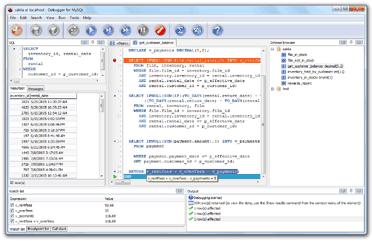
I had in my arsenal of tools, Software like mysqldebugger with which I found an unnoticed bug in decimals calculation in the past surprising everybody.

Previous Engineers involved believed the problem was in the Database side. They were having difficulties to identify the issue by the random nature of the repetitions.

Some times the order lines were duplicated, and other times were the payments, which means charging twice to the customer.

Redis Cluster could also play a part on this, as storing the session information and the basket.

But I had to follow the logic sequence of steps.

If transactions from customer were duplicated that mean that in first term those requests have arrived to the System. So that was a good point of start.

With a list of duplicated operations, I checked the Webservers logs.

That was a bit tricky as the Webserver was recording the Ip of the Load Balancer, not the ip of the customer. But we were tracking the sessionid so with that I could track and user request history. A good thing was also that we were using cookies to stick the user to the same Webserver node. That has pros and cons, but in this case I didn’t have to worry about the logs combined of all the Webservers, I could just identify a transaction in one node, and stick into that node’s log.

I was working with SSH and Bash, no log aggregators existing today were available at that time.

So when I started to catch web logs and grep a bit an smile was drawn into my face. :)

There were no transactions repeated by a bad behavior on MySQL Masters, or by BackEnd problems. Actually the HTTP requests were performed twice.

And the explanation to that was much more simple.

Many Windows and Mac User are used to double click in the Desktop to open programs, so when they started to use Internet, they did the same. They double clicked on the Submit button on the forms. Causing two JavaScript requests in parallel.

When I explained it they were really surprised, but then they started to worry about how they could fix that.

Well, there are many ways, like using an UUID in each request and do not accepting two concurrents, but I came with something that we could deploy super fast.

I explained how to change the JavaScript code so the buttons will have no default submit action, and they will trigger a JavaScript method instead, that will set a boolean to True, and also would disable the button so it can not be clicked anymore. Only if the variable was False the submit would be performed. It was almost impossible to get a double click as the JavaScript was so fast disabling the button, that the second click will not trigger anything. But even if that could be possible, only one request would be made, as the variable was set to True on the first click event.

That case was very funny for me, because it was not necessary to go crazy inspecting the different layers of the system. The problem was detected simply with HTTP logs. :)

People often forget to follow the logic steps while many problems are much more simple.

As a curious note, I still see people double clicking on links and buttons on the Web, and some Software not handling it. :)