Tag Archives: Firewall

Forensics Postmortem Analysis and how abusive bots pushed me to migrate part of my services from Google Cloud to another Cloud provider

I tested Google Cloud when they were in beta, years ago, and I helped their Team to improve the service. And I’ve been using Google Cloud for years.

Here I explain, how an incident, this August, almost made me leave Google Cloud for good. In fact, I migrated many services to other providers. I walk through the steps I took.

The best advice to start with, is, enable Cloud Billing alerts.
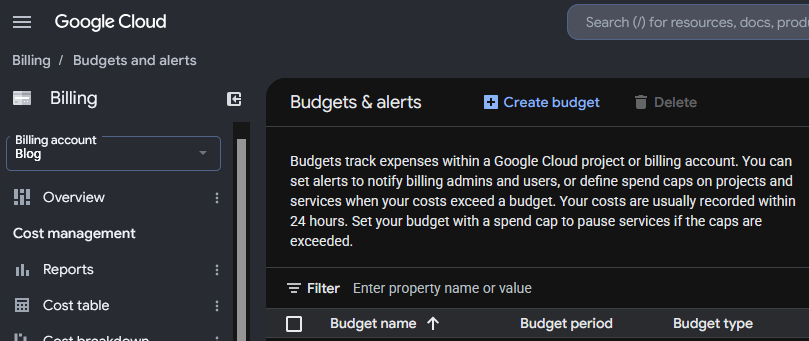
Everything started with the alert of Cloud Billing alerting me that half of the budget for the month had been exhausted around the 7th of the month. I checked the panel, and at the beginning I didn’t pay much attention to it, as Billing was indicating that the extra cost was in Compute in a specific region where I had provisioned new instances and more storage and it was just few euros.

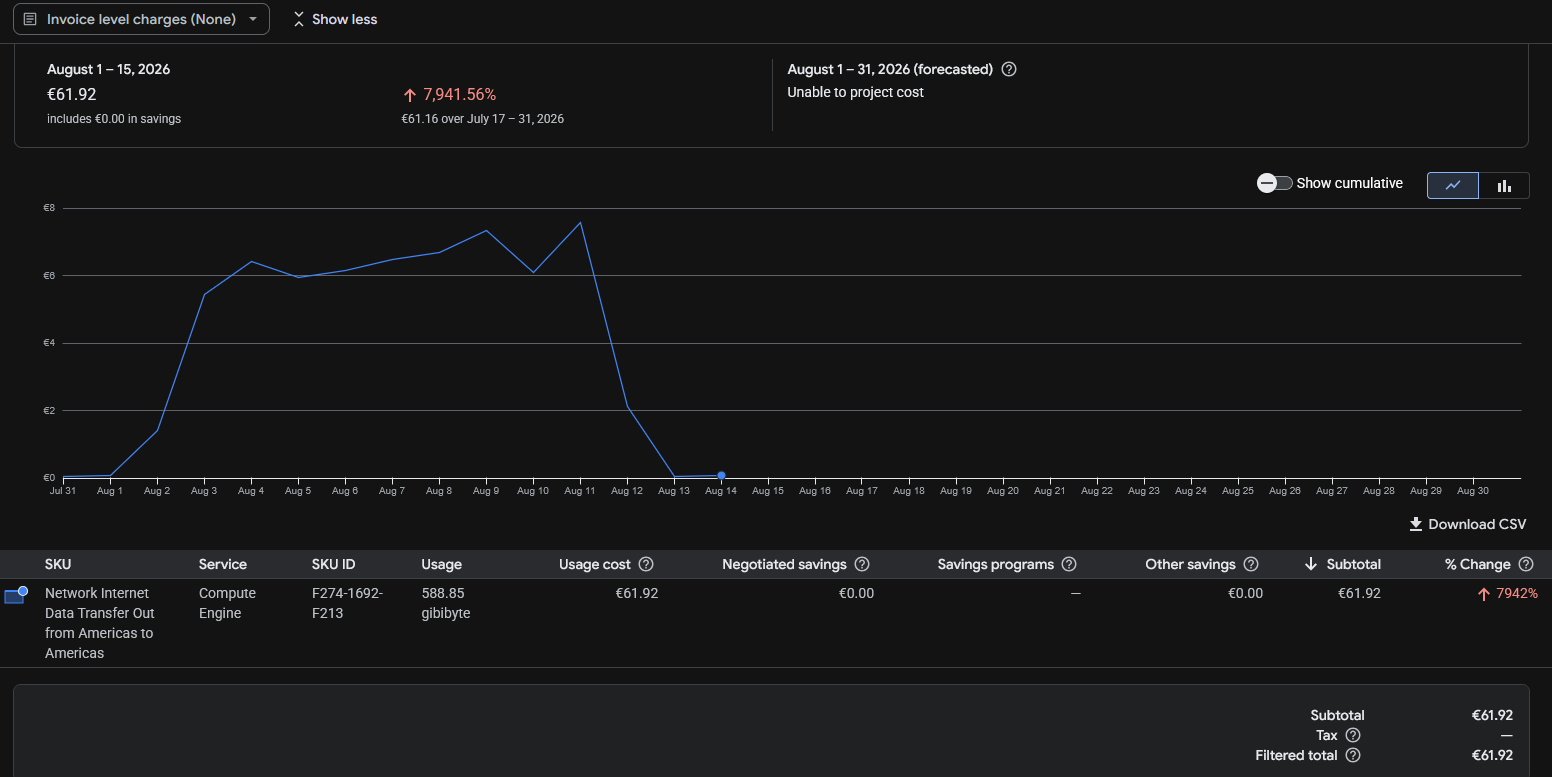
Compute Engine Costs are mixed with the bandwidth consumption in the Dashboards which makes no sense:

So, I had to check different dashboards to realise it was a data transfer issue, and honestly, at the beginning I didn’t know where the problem was, but as I wrongly inferred, that the instance generating egress traffic was the one named “ubuntu26-04” I was investigating mainly that.

The first thing to learn that Google Cloud Billing shows the pure Compute and bandwidth usage together. I dislike it, for obvious reasons.

Next day budget for the month was almost gone.

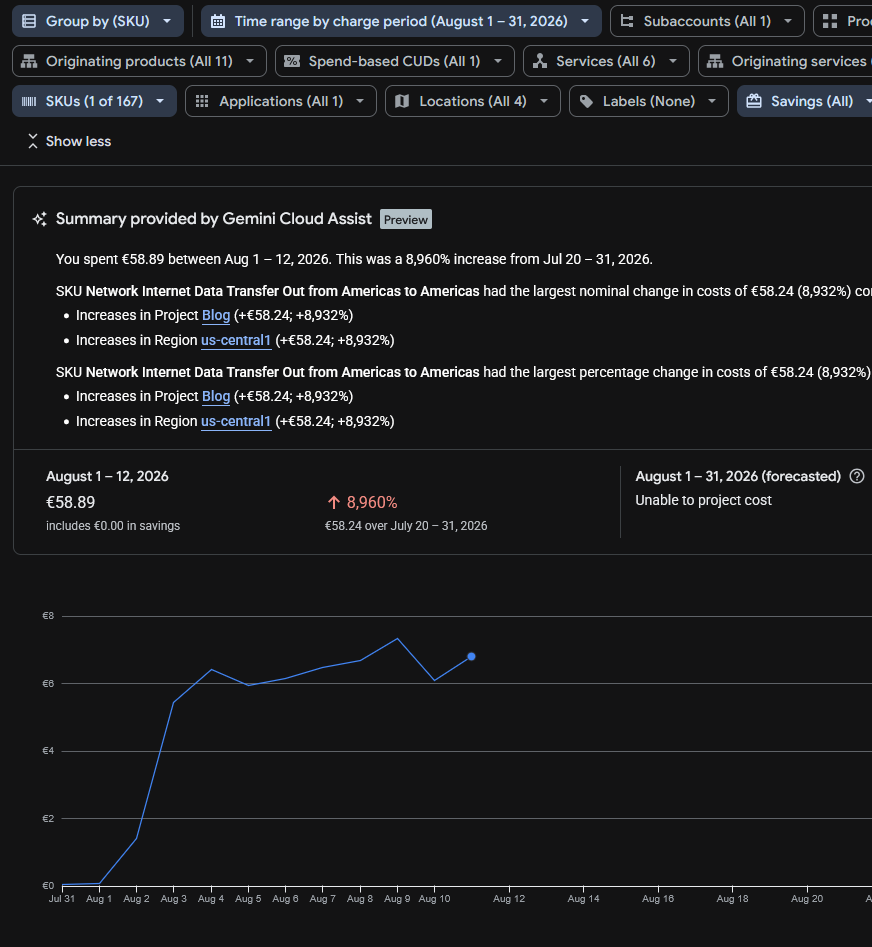
Running the reports I saw “SKU Network Internet Data Transfer Out from Americas to Americas” which was confusing, and initially made me think if it could be the new backups system, sending the backups to my centralised server using the AI compatible agent with the public IP for the API and encryption, but I discarded this very quickly due to the volume of data and I modified the system to use internal IPs instead of the public ones.

The only clear thing at this point was that Internet data transfer (egress) was being sent, and Google makes you pay for that.
I had released several projects recently, like https://read.carlesmateo.com/en Text-to-speech to generate MP3 from text files, or https://sendmeafile.carlesmateo.com/en to send and receive huge files, with resume, checksum verification, AI compatible… So my first thought was that one of the projects or its dependencies could have been compromised, or fanatic AI/crawlers were downloading the sample MP3 files again and again.

I made a mistake when checking Cloud Billing. It indicated that the expenses came from us-central1, so checked the list of instances’ regions and I thought the problem came from a new instance named “ubuntu26-04”.

But I made a mistake, because there are several zones in every region, like us-central1-a, us-central1-b, us-central1-c… My new instance for the new projects was in the zone us-central1-f but I had more than that one instance in the region, only that in different zones. But when I checked the zones for the instances I did not realise that there was more than one instance in the zone us-central1 and I assumed the new instance was the only one in the zone and should be the one generating the egress traffic.

I only had ports 80 and 443 opened in Google’s firewall, so there could be requests to the web server, or that the server got hacked. I analysed the nginx logs for the server and found no huge traffic or big files being requested.

Nowadays bots and crawlers and AI’s generate a crazy amount of traffic, so I had to discard this.

Also, recently Amazon had a problem were it presented huge bills (erroneous) of more than 1 Million dollars to some customers. I didn’t know if Google was calculating the bandwidth costs well.

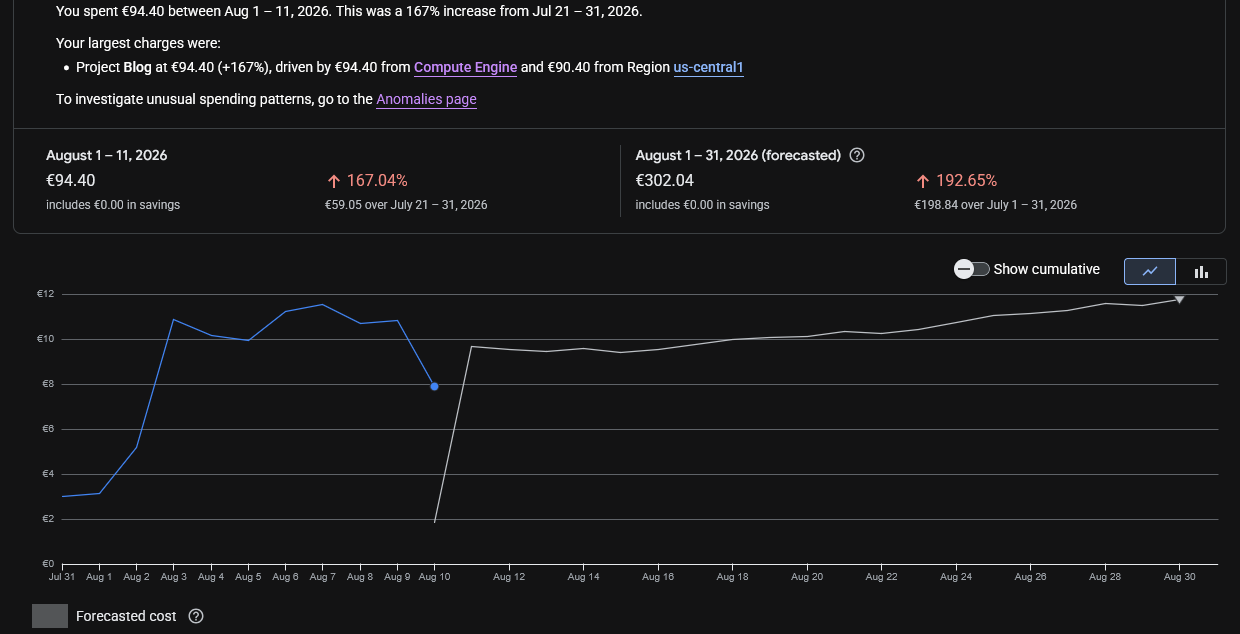
The Billing Dashboard showed that the increment in data sent was costing me around 11€ per day, so it allowed me to start moving services from that server, with relative calm. The forecast for all the August month displayed that the bill would cost me 300€, which was not nice.
In the meantime I hired a VPS with unlimited data and started to migrate the Docker services there as fast as I could with the idea of shutting down the compromise instance to cut the costs.

One of the things that really made me angry, while I was migrating to avoid those over costs, is that I checked again, the next day, the Cloud Billing Reports, the web loaded and informed me that it had changed with news and showed some floating popups pointing how it work and some improvements pushed by the Google Dev Team, and when I continued, the Cloud Billing Report was displaying an unexpected amount of money to pay in August 2026, more than 10 times what I expected, instead of the forecast I saw previously. So it looked like I had to pay that amount for August, and I started to look at what caused that increment of costs quickly, which fas frustrating. And after a while, when I was thinking about stopping the services, I found that Google had changed the page of the reports and the filters were reset to yearly, and the page was showing the already paid costs from 1st August 2025 to 31th August 2026.

Later I reported how frustrating was the experience to Google as “you should not do that” and “users dislike frequent changes”.

Companies are not aware that when they change things, they often annoy the customers a lot.

Years ago I migrated from my long term account with Amazon AWS to Google Cloud Compute Engine cause I was feed up of the problems in Amazon, how many programming errors they had, the changes they did, causing problems, like to the identifiers of the objects (I had older created objects, with shorter hash, and some API calls did not work any more), and how difficult they made simple things. User Interface was bad, and they also lost two of my instances and communicated really poorly (I also reported that to a friend in Amazon and I had some conversations with Amazon’s AWS PMs), and they were over expensive for developers, so I ended migrating to Google Cloud. And now Google is repeating some of the same mistakes.

They are not only expensive. They make things that could be easy, difficult, for the developers.

These big companies force you to stay continuously learning they changes. They offer great solutions for the Enterprise, but for developers and Startups the costs could be overkill.

Probably they are over-kill and over-expensive for developers and Startups.

With Google Cloud I have experienced some technical issues too, as my older instance froze several times and became irresponsive and I had to do a stop from the web console and I had to wait until the command timed out and Google realised there was a problem so it would consider the instance finally shutdown and I could start it again in other non faulty hardware.

If you are a company with a Load Balancer, with health checks, and several front servers, and 20 developers, you can afford to have Web servers KO, as the Load Balancer will handle it nicely, but if you have a single server with WordPress sites, if the instance stops it means that nobody can access those sites.

As an example of costs, for a Google e2-medium (2 vCPUs, 4 GB of Memory and 20 GB of disk) in us-central1 I pay around 30 € per month. And it happens that the forecast for this month in bandwidth was 300 €.

Also storage is around 1€/month per 10GB for standard. So 200GB of regular space is 20 €/month.

For SSD 1.7€/month per 10GB, even tough provides more IOPS, but not more speed. 200GB of space more is 34 € more per month.

I migrated to a provider were I pay 30 € per month for a 8 vCPU and 24 GB of memory and includes 200 GB of NVMe, and I have unlimited bandwidth. Extra storage is also much more cheap. And the static IP is included (for Google you pay around 1.1€ per month).

The key in here was the unlimited bandwidth.

I also could have rented a dedicated server with 64GB of RAM for around 64 €/month, but these comes with some down sides, like if your server experiences a hardware error, you’ll have to wait for the System Administrators from the Cloud Provider to physically replace the components. With a VPS or instance, I can just launch it in a healthy hardware immediately.

As I was migrating services and investigating the origin of the problems, I saw that 500 GB of data were transferred from us-central1 since the 1st of August.

The Billing Report didn’t allow me to filter for IP. It only helped to know the region, us-central1, which helped me to identify the possible services that could be having the problems.

To be honest, I should have located the origin of the problem quickly, but I did so well blocking bots and uneducated crawlers in the past years, that I had no problems for years, and GCE has mad many changes over time, so I did not remember that I could monitor real time network usage of my servers. Most of the servers I troubleshoot I have only SSH access, so I use network tools.

But as I told previously, I mistakenly thought that just one instance was running in us-central1, and that was not the case. They were in different zones of us-central1.

The live traffic inspection in the server with tools like ss, netstat, nethogs, iftop, iotop and ps revealed normal traffic and load.

A second revision from the nginx logs didn’t reveal any problem over time. And the only opened ports were 80 and 443. With the services I considered potentially more vulnerable (as they used python dependencies) migrated to the new VPS and stopped in the “ubuntu26-04” Google server, the usage shown and the forecast for bandwidth was not reduced and it was the same.

One thing I learned, and I suspected it from my tests with https://sendmeafile.carlesmateo.com/en is that the maximum speed that my instances were able to transfer from Google to Internet (egress) was around 50 Mbps per connection.

I didn’t see this in Google Cloud’s documentation, but in my tests transferring data from Google servers using the public interface and from different locations to this google server I consistently achieved always that top speed of around 50 Mbps per connection (around 6.25 MB/s), but when I communicated Google servers using their private interfaces, the speed for a single connection was much more higher. So I assumed that the bandwidth was capped. After seeing the data transferred in the Billing Cloud Report, it looks clear to me that an important part of the server’s bandwidth max was being used. Later, Apache logs, confirmed me many requests at the same exact second.

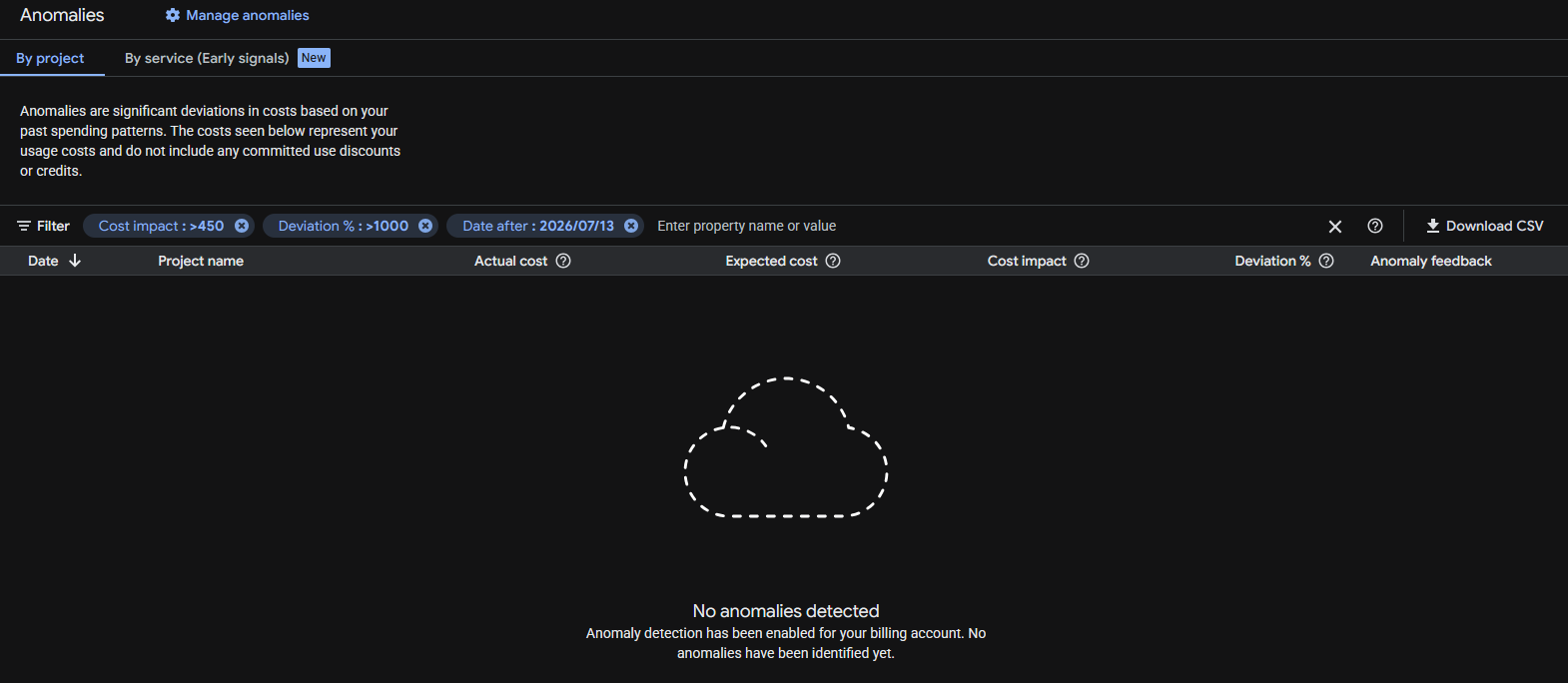
Google anomalies tool detected nothing despite the huge increment in data transfer and cost variation (8,960% respect July!).
Before taking the decision to migrating to another server one has to think, not only in costs, but also on how trustworthy are the storage systems, the resiliency of the systems, how many times they are down per year… there are surprises that you discover as you go. With the experience.

But honestly, I felt it was not worth the price to continue with Google Cloud and it was conditioning the kind of projects I could start. My architecture is resilient, based in containers and I can deploy it fast. I also have backups.

Google storage is not that super trustable in my opinion (neither Amazon’s). Some times my VMs froze and Google monitor dashboard stops drawing the lines of metrics (like CPU usage), but Google doesn’t catch that the VM is frozen. My guess is that the problem is the storage or compute servers dying.

Having to pay per GB transferred in a time where bots and AI index your sites continuously, and abuse the servers by launching many requests concurrently, generating load, and where bots consume much more data than humans, force you to take architecture decisions and to implement strategies.

Possible solutions like using CDN’s like Cloudflare to be protected against DoS, to cache statics and to cut bandwidth and CPU abuse (requests to origin), using other cache systems or migrating to other Cloud providers that are more developer and Start up friendly, and that have unlimited data transfer, etcetera.

When I was presented with the new Google Billing Reports page and the filter was reset to one year, and I saw the price that should be showing multiplied by 10, I contacted Google Cloud by X. They kindly replied and invited me to contact them privately. I did and we opened a ticket. Around three hours later I got an email from a Google staff, telling me that they will investigate the problem, and giving me an expected response deadline of 5 days.

It was nice, but by the time I received the email I already had found and sorted the problem.

I troubleshoot the instance “ubuntu26-04” but the CPU usage was low, and no permanent connections (a sign that could have indicated that was hacked):

That Looked normal

sudo ss -tunp state established

Then I did something that I should have done before, I checked the metrics from all the different instances in Google Cloud Compute, starting from the one I initially guessed was the one suffering the problems. That machine was clear. No high CPU usage. No high bandwidth usage. Nothing.

And then I saw it.

Through VM Instances I narrowed to the one in us-central1 that was consuming the Internet bandwidth, “instance-1”:
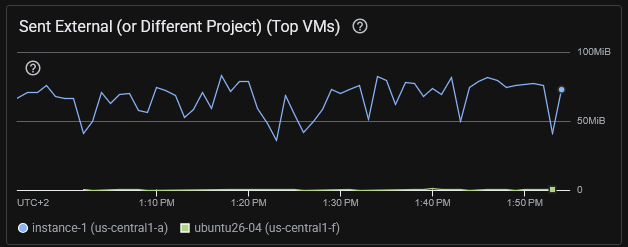
I was checking the wrong server. The consuming excess of egress was from instance-1 that hosted several WordPress sites and it was using Apache2, not nginx.

Some commands I ran:

# Check for the data sent by Apache. This found a lot of traffic. Note: the access.log of all the sites were being analysed
sudo awk '{s+=$10} END {print s/1024/1024/1024 " GB"}' /var/log/apache2/*access.log
# returned 36.4578 GB that's for a day, so something was clearly wrong

# Analyze requests: See what is more heavy. So basically bots trying to hack into the server and some heavy images. Note root home for at least a server is huge (50MB)
sudo awk '{a[$7]+=$10} END {for(u in a) print a[u]/1024/1024" MB\t"u}' /var/log/apache2/*access.log | sort -rn | head -20
54.3218 MB      /
21.6173 MB      /wp-login.php
17.1676 MB      /wp-content/uploads/2022/10/20221001_200930-cut.png
16.5822 MB      /wp-content/uploads/2022/10/20221001_201033.png
10.7245 MB      /wp-content/uploads/2022/02/python_loop.gif
6.61174 MB      /xmlrpc.php
6.60595 MB      /page/2/?shopdetail%2FI37266592159
6.60595 MB      /page/2/?shopdetail%2FI37256267952
6.60595 MB      /page/2/?shopdetail%2FI37256137878
6.60595 MB      /page/2/?shopdetail%2FI37256033568
6.60595 MB      /page/2/?shopdetail%2FI37224959793
6.60595 MB      /page/2/?shopdetail%2FI37214305672
6.60595 MB      /page/2/?shopdetail%2FI37203620584
6.60595 MB      /page/2/?shopdetail%2FE37266925367
6.60595 MB      /page/2/?shopdetail%2FE37242498260
6.60595 MB      /page/2/?shopdetail%2FE37207321261
6.60595 MB      /page/2/?shopdetail%2FA37259909717
6.60595 MB      /page/2/?shopdetail%2FA37259600135
6.60595 MB      /page/2/?shopdetail%2FA37256306882
6.60595 MB      /page/2/?shopdetail%2FA37256197883

# Analyze requests: See what IP's are requesting more traffic in total. Gotcha
sudo awk '{a[$1]+=$10} END {for(i in a) print a[i]/1024/1024" MB\t"i}' /var/log/apache2/*access.log | sort -rn | head -20
34549.2 MB      74.7.241.60
1491.36 MB      116.202.235.23
287.651 MB      3.41.188.33
232.362 MB      74.7.227.160
199.987 MB      18.97.9.169
183.748 MB      66.249.74.42
84.1681 MB      114.119.140.64
78.3209 MB      114.119.149.169
70.5166 MB      114.119.156.46
67.8224 MB      114.119.150.29
66.7544 MB      114.119.145.237
58.7278 MB      114.119.147.113
57.1822 MB      114.119.162.62
56.0061 MB      66.249.74.43
55.3612 MB      114.119.141.79
21.9245 MB      216.73.217.35
21.2516 MB      104.243.44.93
17.7313 MB      79.116.217.181
17.1676 MB      189.81.71.184
16.5822 MB      205.188.63.181

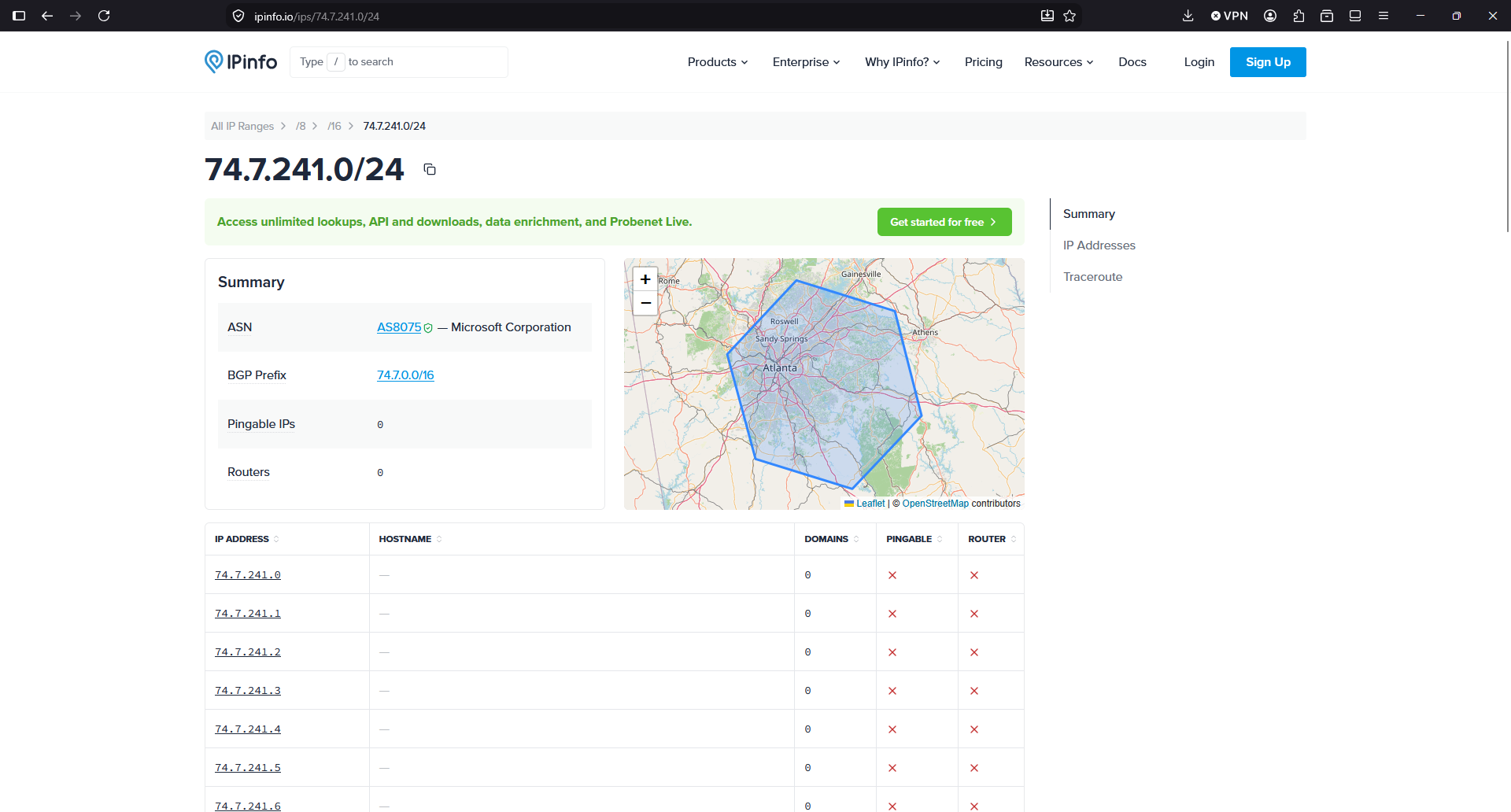
So we see that this IP 74.7.241.60 is requesting 34.5 GB in a day.

So, according to this IP Info service, the IP is from Microsoft. So apparently, crawlers/IA from Microsoft or running in Microsoft infrastructure, were costing me money because they are abusing, scanning my sites, with many connections concurrently, like horrible soulless machines:
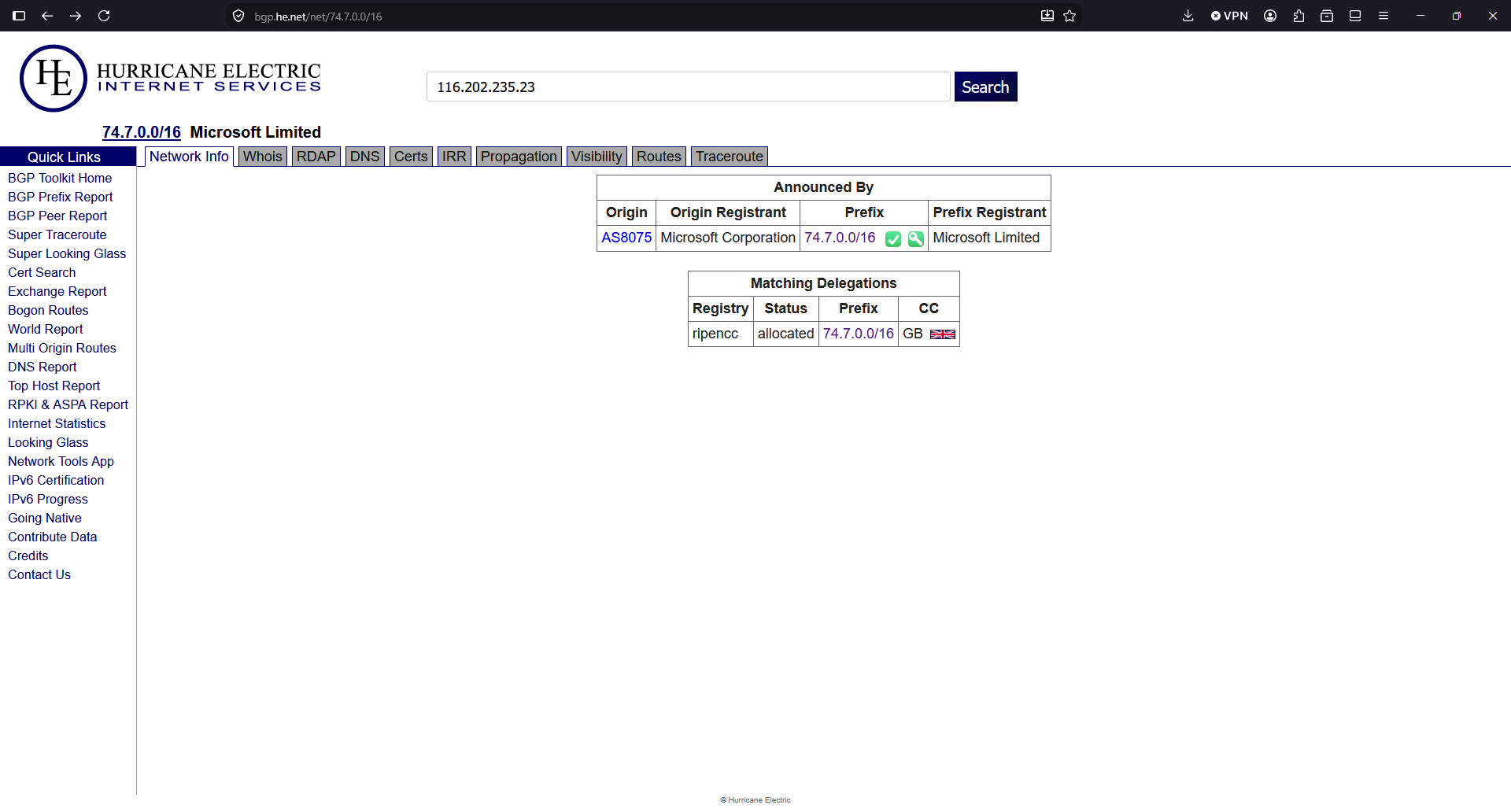
I double checked the IP with another provider:
A command to see a sample of what kind of requests I have from this IP, brings more light:

grep "74.7.241.60" /var/log/apache2/*access.log | head -20
/var/log/apache2/www_mysqlproxycache_com-access.log:74.7.241.60 - - [13/Aug/2026:00:00:22 +0000] "GET /page/2/?shopdetail%2FI37207088742 HTTP/1.1" 200 3463409 "http://www.mysqlproxycache.com/page/2/?shopdetail/I37207088742" "Mozilla/5.0 AppleWebKit/537.36 (KHTML, like Gecko; compatible; GPTBot/1.4; +https://openai.com/gptbot)"
/var/log/apache2/www_mysqlproxycache_com-access.log:74.7.241.60 - - [13/Aug/2026:00:00:34 +0000] "GET /page/3/?shopdetail/I37207088742 HTTP/1.1" 301 264 "http://www.mysqlproxycache.com/page/2/?shopdetail/I37207088742" "Mozilla/5.0 AppleWebKit/537.36 (KHTML, like Gecko; compatible; GPTBot/1.4; +https://openai.com/gptbot)"
/var/log/apache2/www_mysqlproxycache_com-access.log:74.7.241.60 - - [13/Aug/2026:00:00:35 +0000] "GET /page/3/?shopdetail%2FI37207088742 HTTP/1.1" 200 1900262 "http://www.mysqlproxycache.com/page/3/?shopdetail/I37207088742" "Mozilla/5.0 AppleWebKit/537.36 (KHTML, like Gecko; compatible; GPTBot/1.4; +https://openai.com/gptbot)"
/var/log/apache2/www_mysqlproxycache_com-access.log:74.7.241.60 - - [13/Aug/2026:00:00:37 +0000] "GET /page/7/?shopdetail/E37249347969 HTTP/1.1" 301 264 "http://www.mysqlproxycache.com/page/6/?shopdetail/E37249347969" "Mozilla/5.0 AppleWebKit/537.36 (KHTML, like Gecko; compatible; GPTBot/1.4; +https://openai.com/gptbot)"

According to the User-Agent is GPTBot. So apparently a bot running in Microsoft self-identifying as OpenAI were killing causing high usage to my server and to my budget by requesting many pages at the same time, for an old shopdetail page that does not exist in that server (maybe there was a shop years before I got that IP), and spends a lot of bandwidth responding with a heavy page of 6 MB.

In the logs I saw many request at the same precise second.

Asking to Claude it tells me that the range of IPs of the Microsoft attacker IP are not in the publicly published IPs of OpenAI for GPTBot, so apparently somebody using Microsoft IPs is pretending to be a GPT Bot, and it isn’t:

The domain is an old WordPress that has been hacked. Yes, this happens more often that we would like, with WordPress.

I checked the https and it returns a SSL potential warning in the SSL.

I tried with http http://www.mysqlproxycache.com/page/7/?shopdetail%2FI37224744693 (one of the requests in the logs) and I saw that the WordPress site was hacked.
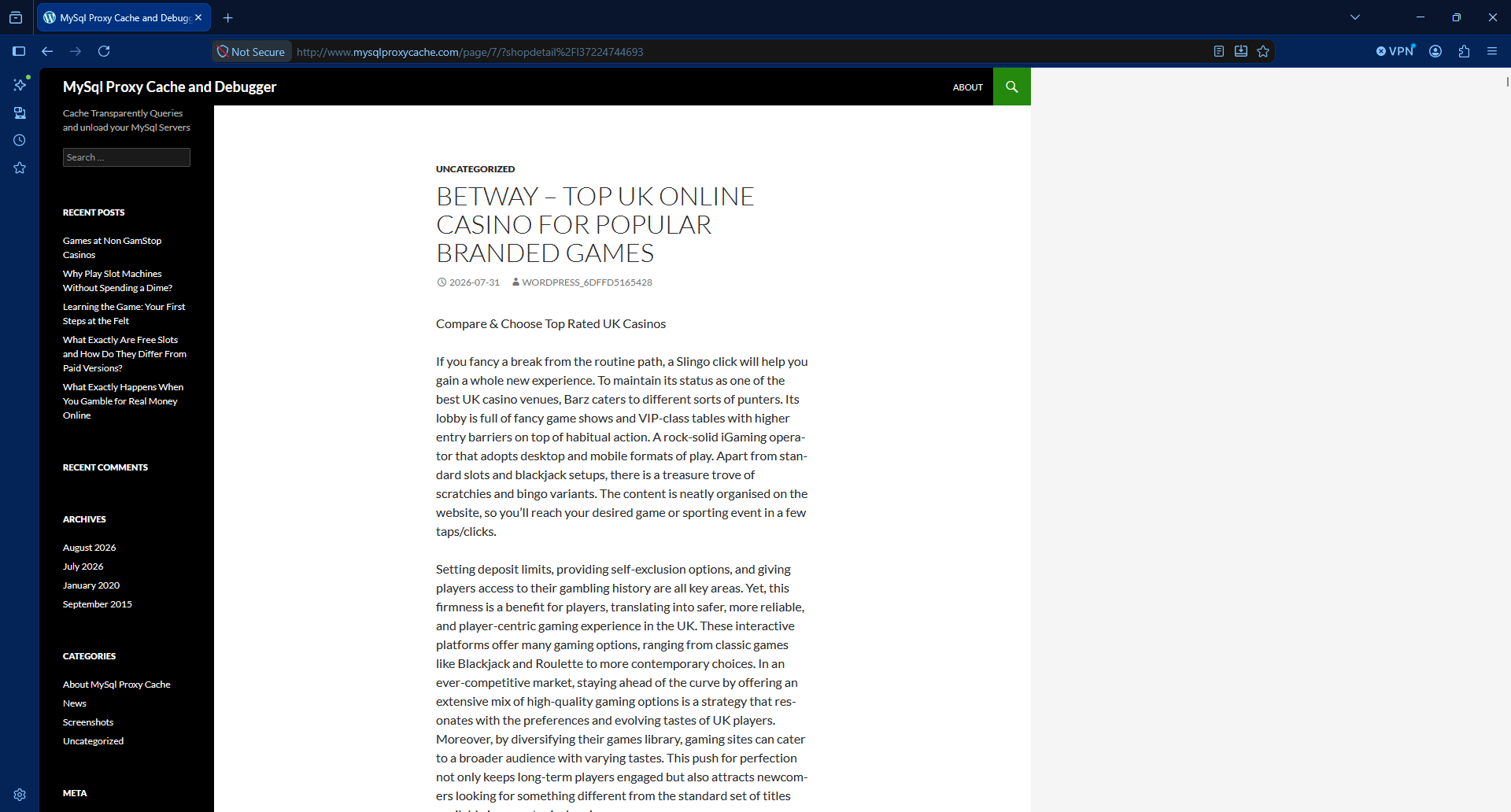
So first things first: I stopped Apache.

sudo service apache2 stop

So, to summarise, there was a bot from a Microsoft IP, that was requesting many times per second pages to a WordPress site that was compromised and it was returning a large article with many photos, so heavy in terms of data usage.

With Apache2 server stopped, I moved the config symbolic link from /etc/apache2/sites-enabled/ to another folder /etc/apache2/sites-disabled/ that I created.

So basically, when I started Apache, the compromised site will not be served. It will be served by the default site.

I restarted the Apache server and checked that the URLs for that domain were catch by default site and no processing resources of bandwidth was used.
That was to avoid a main site marked as default in the Apache config to attend those requests and waste data.

And then I added to the firewall, to Google Cloud’s Firewall and to the servers in all my instances, to block all the IPs from Microsoft from that range.

I saw that the BGP Prefix is 74.7.0.0/16 so I block all the 65,536 IP Addresses:

ufw insert 1 deny from 74.7.0.0/16 to any

As you can see I inserted this rule on the first position. Don’t just add it with ufw deny from 74.7.0.0/16 to any or otherwise it will go to the last position, after the allow rules. And then it would not be enforced.

Check your rules with:

ufw status numbered

You can block the range in your provider’s Firewall (VPC Firewall in Google Cloud).

If you didn’t have the Ubuntu Firewall active, and want to activate it now, make sure that you have the rules for the SSH connection:

echo "Enabling SSH"
sudo ufw allow 22/tcp

echo "Enabling Web 443 and 80"
#sudo ufw allow "Apache Full"
sudo ufw allow 80/tcp
sudo ufw allow 443/tcp

echo "Enabling Firewall"
sudo ufw enable

echo "Showing rules"
sudo ufw status numbered

I recommend you to add the rules to a script in git (Infrastructure as Code), so you can replay it another day, and to any server you have.

By default, ufw sets deny by default for rules not specified. You can check it with:

sudo ufw status verbose | head

Bots, IA, crawlers abuse our servers nowadays.

Also the automated bots attempting to hack into the servers.

If you just check your logs, you’ll see many attempts to exploit vulnerabilities in your servers, every day.

I checked for the second IP consuming more bandwidth in the list:

116.202.235.23

It’s from hetzner, a Cloud provider. https://bgp.he.net/net/74.7.0.0/16
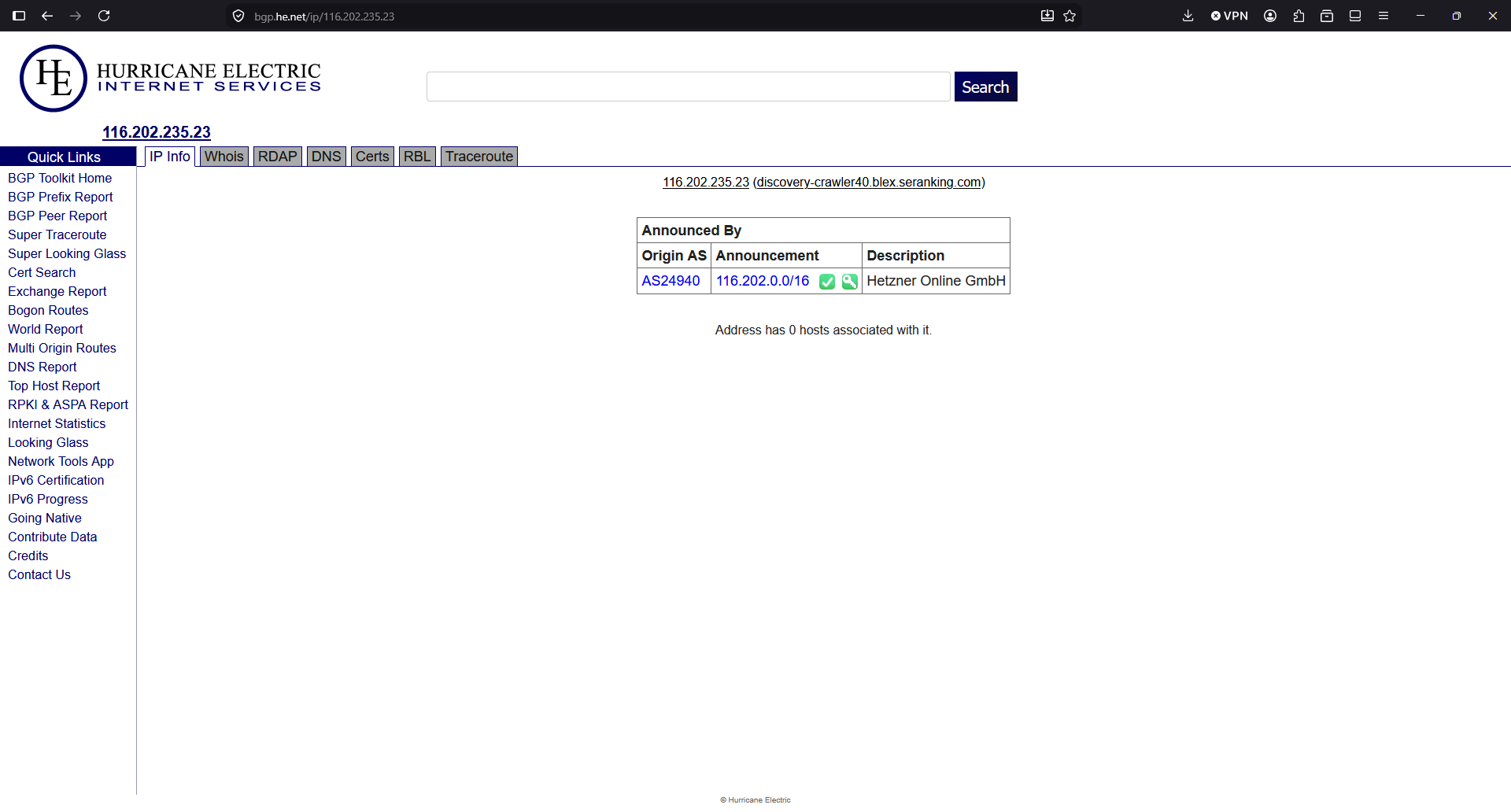
Another 65,536 addresses that get blocked:

# Hetzner
ufw insert 1 deny from 116.202.0.0/16  to any

The third IP will be blocked too, even if I didn’t find any information about who owns the block of IPs.

ufw insert 1 deny from 3.41.188.33 to any

The fourth was part of the same block I blocked first, so it’s already blocked.

The fifth IP, I ask to Google Gemini:
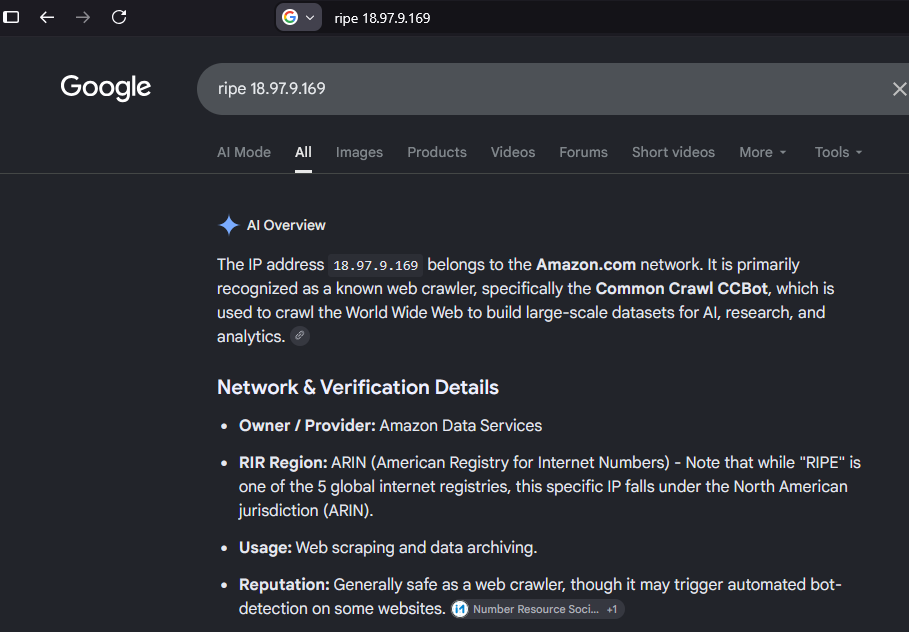
The block is 18.97.9.0/24 but I’ll block all the BGP Prefix, all the 16K addresses.
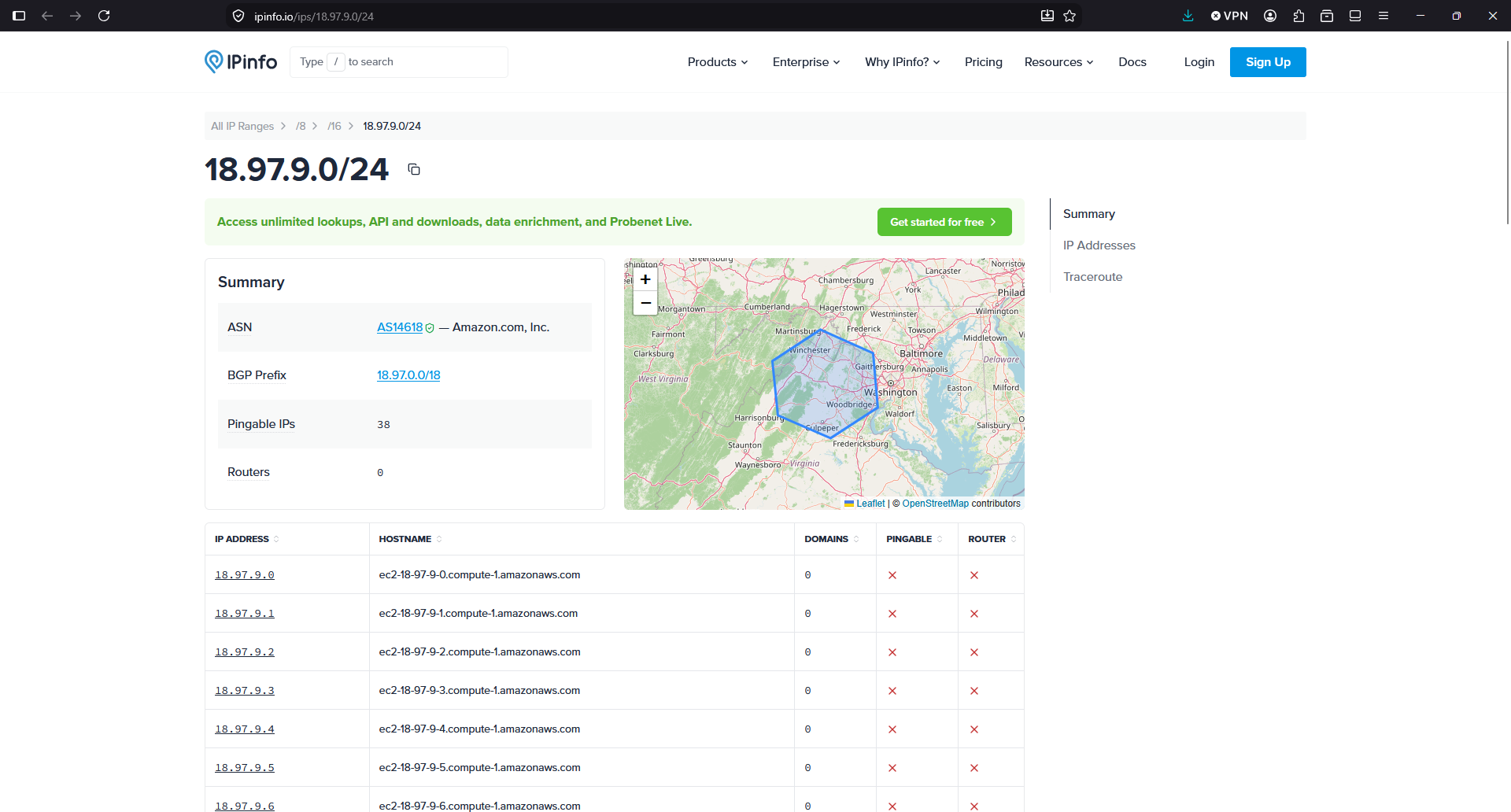
ufw insert 1 deny from 18.97.0.0/18 to any

See what is the traffic from the servers since I blocked the Microsoft range in the Ubuntu Firewall:
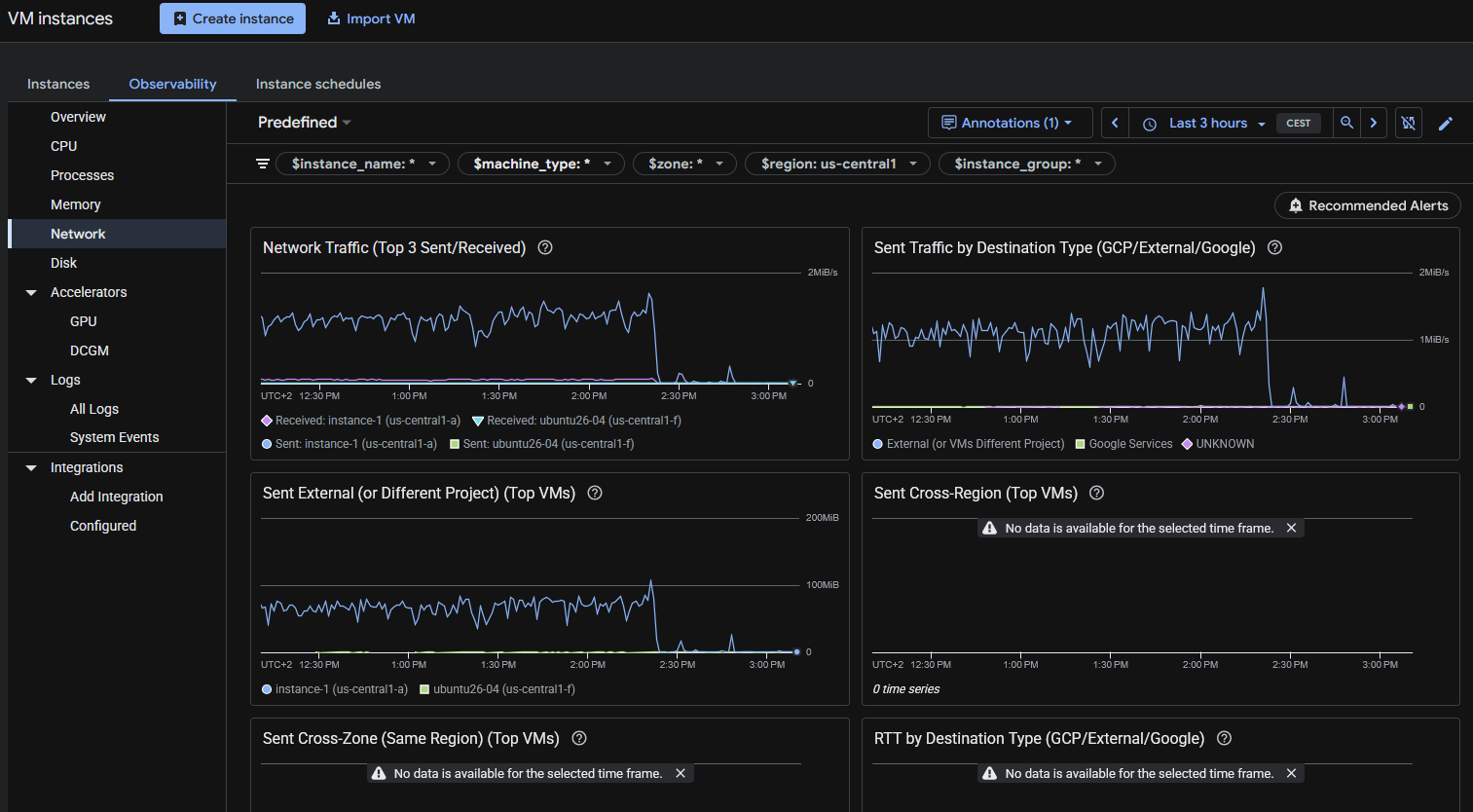
As you can see, after I blocked the first abusive IP allegedly from Microsoft with seemingly OpenAI User-Agent falsified, all the egress traffic went down.

I like how Google reacted when I contacted them. And I should have checked the Network traffic bandwidth first. So I decided to keep the WordPress instance in Google Cloud.

But the new instance “ubuntu26-04” I’m migrating it to the new server. What they offer for the price is much better, and the price of the storage really it’s important for some of my projects. The unlimited bandwidth usage in the new provider it’s also key.

The Billing report from Google Cloud doesn’t show the data up to the moment. But the 16th of August I was able to see that from the 12th and absolutely on 13th and 14th the egress Internet cost have almost disappeared.
Not all is perfect. I had to learn the web interface from that provider (I used it in the past, but companies change the user interface very often nowadays, causing headaches to users), the place were my VPS was listed was hidden and difficult to find, and by default the VPS had no firewall enabled. Something that I believe that is basic to have enabled by default.

But I think it will be great for my projects and for my budget, to have all those new resources available (8 vCPU and 24 GB of RAM and 200 GB of NVMe disk for the same cost provided in Google Cloud of 2 vCPU and 4 GB of RAM and 20 GB of standard disk).

In fact, the speed I have detected transferring from/to sendmeafile with the new provider shows a great improvement.

Take one thing in mind: They AI is hungry for contents, and the mega-rich AI providers are making you pay the bill, by scanning your sites non-stop.

The new provider says it provides 3 Gbps of bandwidth for the instance, with no data usage limits (not having to pay for GB transferred). If I had not reacted fast, the forecast for this month with Google for just a single instance was 300€. It is a risk for developers and small companies, to have the possibility to face a huge bill because more frequent every day bots/crawlers/AIs and processes attempting to breach in your servers, cause your server to use a lot of egress data. So it is worth considering using a Cloud Provider with unlimited data plan. Or at least, activate the Billing Alerts to be notified if your costs exceed a certain threshold.

If you have problems with abusive bots degrading your WordPress performance, I created a commercial WordPress plugin that automatically records and blocks offending IP Addresses.

News from the Blog 2022-06-22

For the first part of June I’ve been quiet on Social Media as I was on holidays and taking some scheduled tests for my health in the hospital.

Carles in the Media/Press/Streaming

Twitch

I started streaming live Python coding sessions in Twitch. I’m giving it a try to see if coders have engagement.

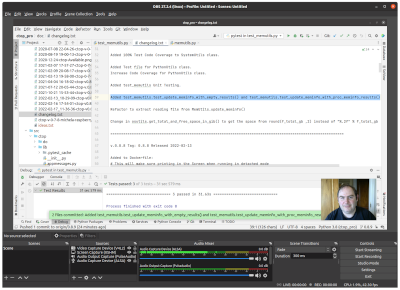
The Software I use to broadcast from Linux is OBS.

I started with my Open Source project ctop.

I had a very long and interesting session on 2022-06-06 about OpenZFS, Data Centers, NVMe, iSCSI, Hard Drives, Storage, performance, Data Centers

More funny things happened like when I was installing a VirtualBox VM live, and the ZFS pool became irresponsible due hardware errors in one SATA Spinning drive.

Things from broadcasting live…

Some of the feedback I got from talented Engineers is that even if the original matter to talk about was interesting, seeing everything falling apart live due to unexpected hardware problems, and me troubleshooting live is being the best of the show… which I found very amusing.

RAB Radio the new digital world

I keep doing my radio space for Radio America Barcelona, once per week, addressed to the Catalan Community across the world and expats.

This radio program, streamed also via Twitch, is available in Catalan language only. RAB.

Open Source

carleslibs

I’ve been working in version 1.0.8 branch, and after a session of refactor on Twitch where I found a bug in MenuUtils class, I fixed it and released v. 1.0.8. You can see the video on the link.

Now I’m working on the branch v. 1.0.9.

ctop

I’ve been working in the branch 0.8.9.

My first Twitch broadcast was about adding Unit Testing to MemUtils class.

You can see all my videos:

http://www.youtube.com/channel/UCYzY-2wJ9W_ooR64-QzEdJg

Infrastructure

OpenStack

I recommend you the videos in this page about Operating OpenStack at Scale.

Some of my Blizzard colleagues talk on it.

https://superuser.openstack.org/articles/upgrades-in-large-scale-openstack-infrastructure-openinfra-live-episode-6/

https://www.openstack.org/videos/summits/denver-2019/how-blizzard-entertainment-uses-autoscaling-with-overwatch

My last physical server in a Data Center

This week I decommissioned my last physical server in a Data Center.

It has been a long journey since I created my company to launch my own projects, and I started having my own infrastructure, back at 2000.

I was offering VPS at that time, with VMWare as Hypervisor.

This last Rack Server served me well for 21 years.

Now everything is Cloud, and is not viable to host and maintain servers unless this is your main occupation. Server’s motherboards die, hard drives die and they need to be replaced. Maintaining infrastructure it’s a full time job and you require somebody to do it. Also using fixed servers only prevents you from moving fast, locks a lot of money, and from spawning more compute capacity.

If you are curious this Rack Server is a Super Micro with Intel Xeon processor and SCSI drives.

Security

Firewall

I keep blocking thousands of IP Addresses every day.

When I see a pattern of an IP trying an attacks against the Server I look at the IP and if it’s from a hosting provider I just block the entire range.

I keep blocking any IP Address coming from Russia or Belarus since they invaded Ukraine.

My Health

I visited the hospital for a programmed following on my health.

The analysis are super good, and it’s super clear that I’ve improved radically. My discipline with the diet, taking the medicines and doing exercise regularly has been crucial.

My Doctor is confident that I’ll have a full recovery, but to do so I need to loss a lot of weight in a year or two.

So, I need to focus on my health and in doing exercise, being happy and avoid any kind of negative stress.

The cost of the travels and the medicines have put some stress into my economy, but I’m fortunate that I can handle it.

Entertainment / Life / Reflections

Star Wars and racism

I’m really enjoying new Start Wars series Obi Wan, and I’ve been profoundly shocked to read that there are fans being racist against the black characters.

https://www.theverge.com/2022/5/31/23148468/star-wars-obi-wan-moses-ingram-third-sister

So just writing here to show my support to human beings from all races, genders including transgender, LGTB+, conditions and preferences.

News from the blog 2021-09-07

  • Blocking Ip addresses in the firewall

I’ve been blocking entire ranges from Cloud Providers, as some of their Ip’s were being used to try to hack/abuse the blog.

After some time blocking individual Ip’s, I opted for being some more effective and blocking /24 (the class C for the offending Ip).

If you work for a CSP and you can’t see my blog from your range, this is the reason.

  • I have updated my two Python books.

For Python 3 simple exercises for beginners I’ve added this new content:

v.0.29 and v.0.28 Python 3 Simple Exercises for Beginners
Added a new section Games, with a first game “Guess my number”

Provided a solution for the recipe Exercise 3: Create a function that will ask a user for a number from Keyboard input, and return the result, only when the value is between the accepted ranges.

Added two new questions to the Quiz section.

Fixed a docstring in Recipes Exercise 4, referring to a String return value which it was an Integer.

Added an exercise for retrieving a JSON with your public Ip

Added a new exercise for converting bytes to kilobytes with two decimal positions.

Added a new exercise / recipe to SSH to a Server with Username and Password and execute a command, using the Paramiko library.

For Python 3 Combat Guide I have added this new content:

v.1.02 Python 3 Combat Guide

Added a new exercise / recipe to SSH to a Server with Username and Password and execute a command using Paramiko library. I added two examples executing commands uptime and df -h /

Show an alternative way to run Flask apps.

Added new interesting packages.

As long as covid is active I plan to keep the minimum price of each of my books at the minimum accepted by LeanPub which is USD $5.

I also enable bundles and enable LeanPub to make punctual discounts to make them even more affordable to humble pockets.

  • I’m going to teach an initiation to programming class, a live Zoom session of 1 hour, plus 15 minutes for questions, for Free. It will be a very basic starting class for absolute beginners.

It will be performed at a time around 19:00 Irish time, wich is 11:00 AM in Irivine, CA time, to maximize the opportunities for people to assist.

If you would like to join, write me an email:

There are not many spots available, but if there is no room for you this time I may contact you for the next time.

This version adds class StringUtils, and a set of methods to perform different useful tasks with Strings, like converting a number to the biggest unit with sense, like a large number of bytes to PB, a smaller one to TB, or GB, MB, KB, justifying strings to the right or to the left, and cap the number of chars to a specified one, etc…

I have many libraries that I’ve been building across the years, and I’m liberating them as Open Source, as soon as I have time to make sure that are compatible with Python 3.5 or superior (and with Python 2.6 when possible), and I have time to add a decent Unit Testing Code Coverage.

I try to release libraries that have no other dependencies. After that I’ll start releasing my libs that have dependencies, like to work with MySQL, SQLite, web scrapping, etc…

News from the blog 2020-10-16

  • I’ve been testing and adding more instances to CMIPS. I’m planning on testing the Azure instance with 120 cores.
  • News: Microsoft makes an option to permanently remote work

https://www.bbc.com/news/business-54482245

  • One of my colleagues showed me dstat, a very nice tool for system monitoring, and bandwidth of a drive monitoring. Also ifstat, as complement to iftop is very cool for Network too. This functionality is also available in CTOP.py
  • As I shared in the past news of the blog, I’m resuming my contributions to ZFS Community.

Long time ago I created some ZFS tools that I want to share soon as Open Source.

I equipped myself with the proper Hardware to test on SAS and SATA:

  • 12G Internal PCI-E SAS/SATA HBA RAID Controller Card, Broadcom’s SAS 3008, compatible for SAS 9300-8I.
    This is just an HDA (Host Data Adapter), it doesn’t support RAID. Only connects up to 8 drives or 1024 through expander, to my computer.
    It has a bandwidth of 9,600 MB/s which guarantees me that I’ll be able to add 12 SAS SSD Enterprise grade at almost the max speed of the drives. Those drives perform at 900 MB/s so if I’m using all of them at the same time, like if I have a pool of 8 + 3 and I rebuild a broken drive or I just push Data, I would be using 12×900 = 10,800 MB/s. Close. Fair enough.
  • VANDESAIL Mini-SAS Cables, 1m Internal Mini-SAS to 4x SAS SATA Forward Breakout Cable Hard Drive Data Transfer Cable (SAS Cable).
  • SilverStone SST-FS212B – Aluminium Trayless Hot Swap Mobile Rack Backplane / Internal Hard Drive Enclosure for 12x 2.5 Inch SAS/SATA HDD or SSD, fit in any 3x 5.25 Inch Drive Bay, with Fan and Lock, black
  • Terminator is here.
    I ordered this T-800 head a while ago and finally arrived.

Finally I will have my empty USB keys located and protected. ;)

Remember to be always nice to robots. :)

Blocking some offending Ip’s easily with Ubuntu ufw

Ok, so we know that there are several ip’s that have attempted to hack the blog.

We know they try different urls looking for a exploit, or they try to hack a password by brute force…

We are using Amazon EC2 and the old infrastructure, not a VPC Network, so we cannot block a specific Ip to our Web Server.

In an article from 2015 I explained How to Stop a BitTorrent based DDoS attack, and was using iptables for that.

In this example I will show how to use ufw to block tow specific Ip’s, execute as root or with sudo:

ufw insert 1 deny from 89.35.39.60 to any
ufw insert 2 deny from 85.204.246.240 to any
ufw allow OpenSSH
ufw allow 22/tcp
ufw allow "Apache Full"
ufw enable
ufw status numbered

You can do ufw status numbered to see the status of ufw and the rules order.

root@ip-111-111-111-111:/home/ubuntu# ufw status numbered
Status: active
To Action From
-- ------ ----

[ 1] Anywhere DENY IN 89.35.39.60
[ 2] Anywhere DENY IN 85.204.246.240
[ 3] Apache Full ALLOW IN Anywhere
[ 4] OpenSSH ALLOW IN Anywhere
[ 5] 22/tcp ALLOW IN Anywhere
[ 6] Apache Full (v6) ALLOW IN Anywhere (v6)
[ 7] OpenSSH (v6) ALLOW IN Anywhere (v6)
[ 8] 22/tcp (v6) ALLOW IN Anywhere (v6)
root@ip-111-111-111-111:/home/ubuntu#

If you need to delete a rule, use the number on the left and, just type:

sudo ufw delete 2

CTOP.py

For updated information visit the main page for CTOP.py

Current stable version is v.0.8.9 updated on 2022-07-03.

Current branch under development is v.0.8.10 updated on 2022-07-03.

Version 0.8.0 added compatibility with Python 2, for older Systems.

Find the source code in: https://gitlab.com/carles.mateo/ctop

Clone it with:

git clone https://gitlab.com/carles.mateo/ctop.git

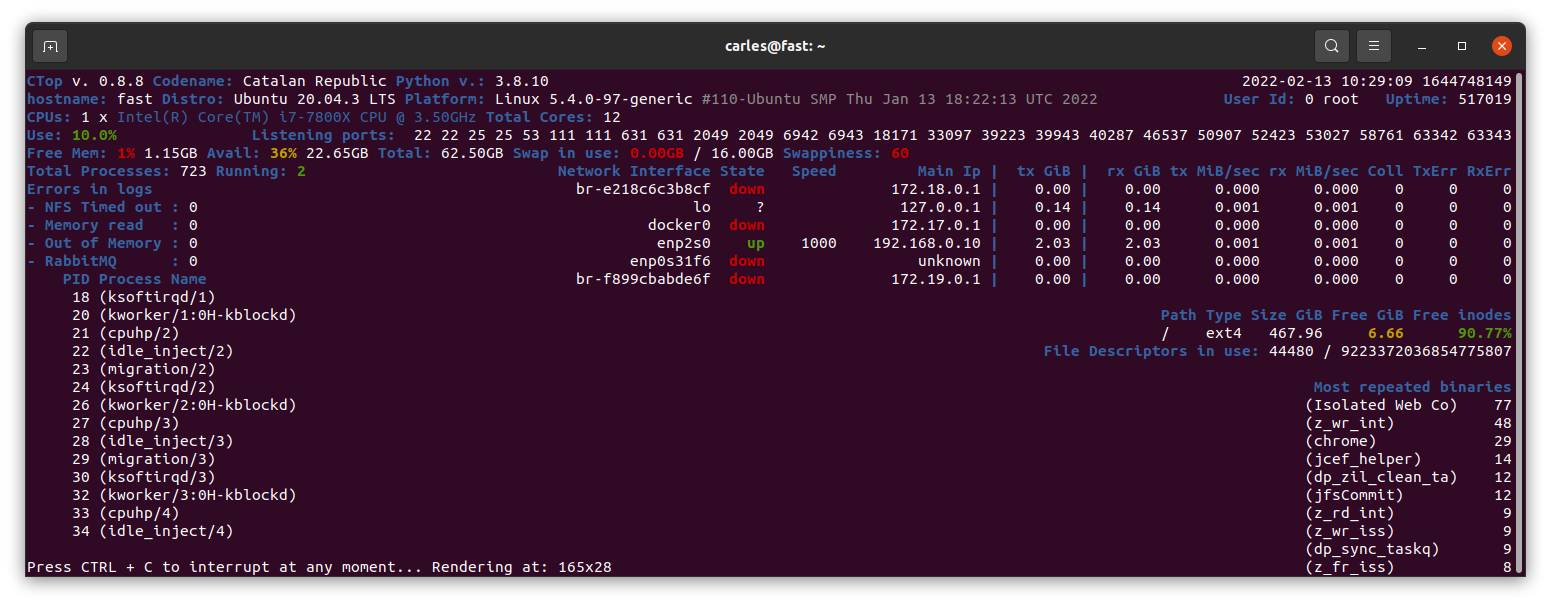
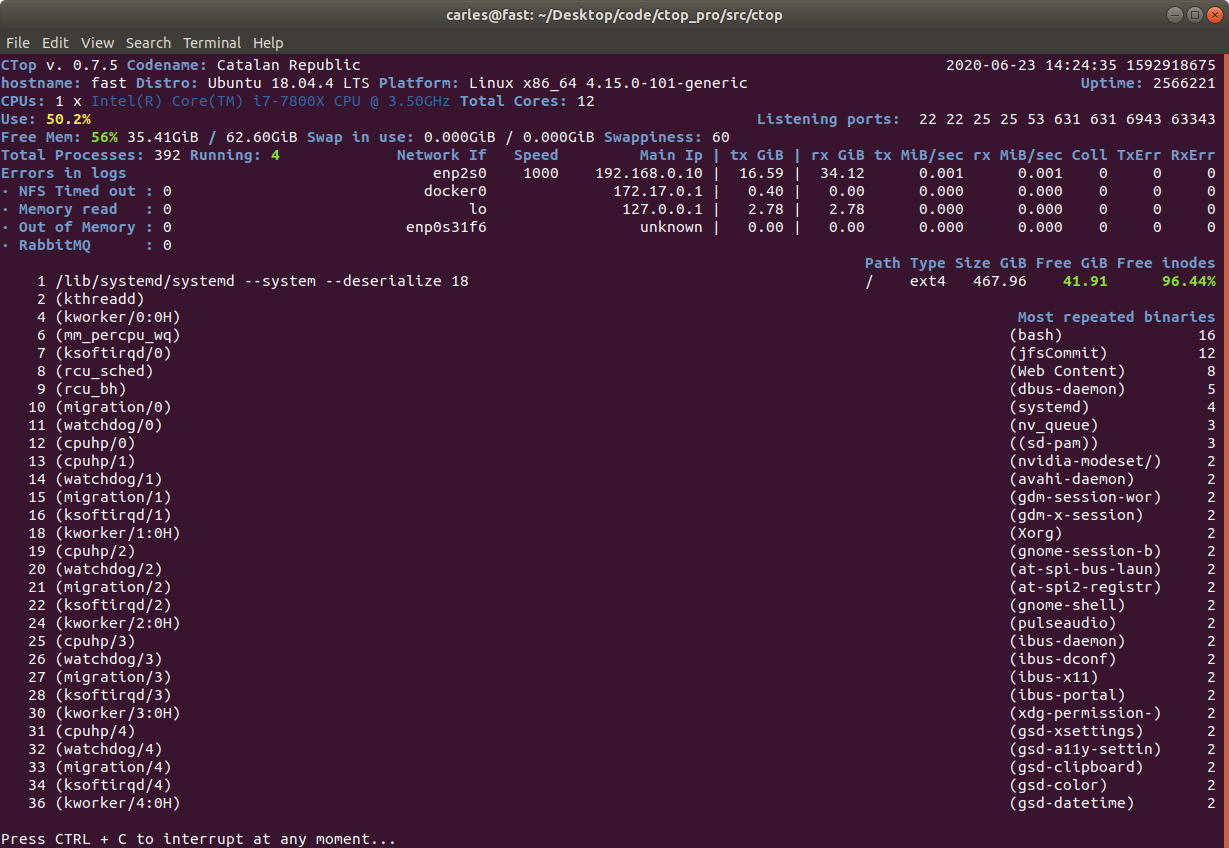
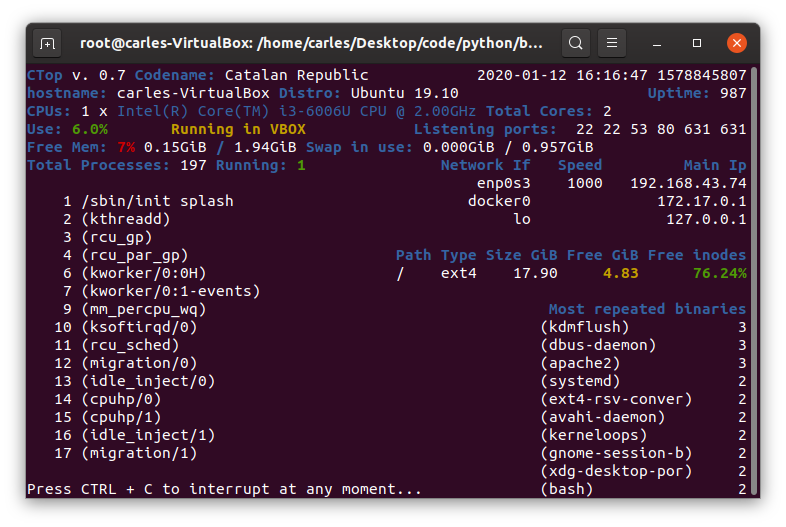
ctop.py is an Open Source tool for Linux System Administration that I’ve written in Python3. It uses only the System (/proc), and not third party libraries, in order to get all the information required.
I use only this modules, so it’s ideal to run in all the farm of Servers and Dockers:

  • os
  • sys
  • time
  • shutil (for getting the Terminal width and height)

The purpose of this tool is to help to troubleshot and to identify problems with a single view to a single tool that has all the typical indicators.

It provides in a single view information that is typically provided by many programs:

  • top, htop for the CPU usage, process list, memory usage
  • meminfo
  • cpuinfo
  • hostname
  • uptime
  • df to see the free space in / and the free inodes
  • iftop to see real-time bandwidth usage
  • ip addr list to see the main Ip for the interfaces
  • netstat or lsof to see the list of listening TCP Ports
  • uname -a to see the Kernel version

Other cool things it does is:

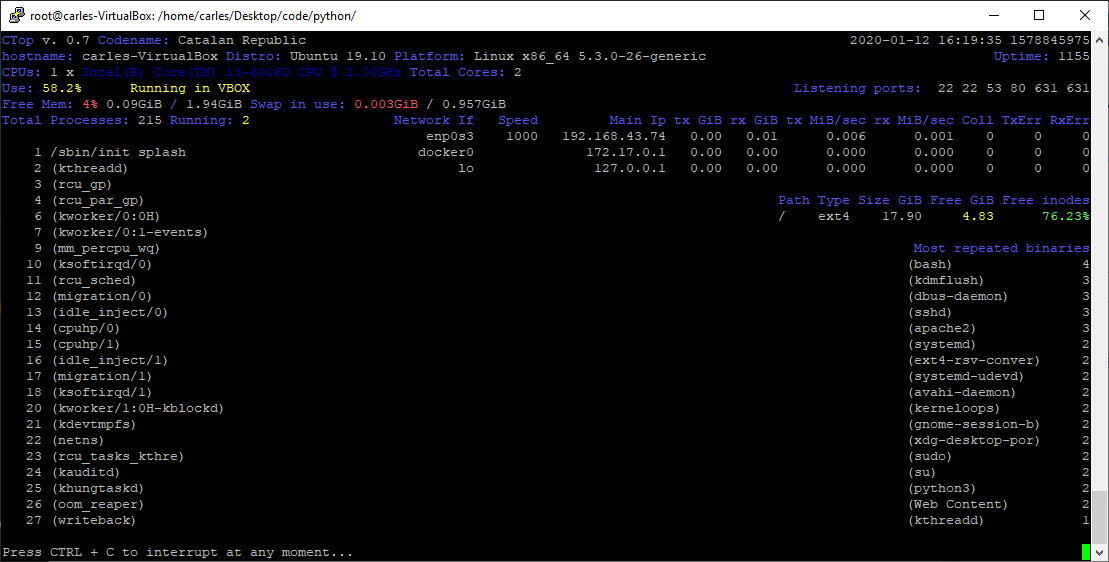
  • Identifying if you’re inside an Amazon VM, Google GCP, OpenStack VMs, Virtual Box VMs, Docker Containers or lxc.
  • Compatible with Raspberry Pi (tested on 3 and 4, on Raspbian and Ubuntu 20.04LTS)
  • Uses colors, and marks in yellow the warnings and in red the errors, problems like few disk space reaming or high CPU usage according to the available cores and CPUs.
  • Redraws the screen and adjust to the size of the Terminal, bigger terminal displays more information
  • It doesn’t use external libraries, and does not escape to shell. It reads everything from /proc /sys or /etc files.
  • Identifies the Linux distribution
  • Supports Plugins loaded on demand.
  • Shows the most repeated binaries, so you can identify DDoS attacks (like having 5,000 apache instances where you have normally 500 or many instances of Python)
  • Indicates if an interface has the cable connected or disconnected
  • Shows the Speed of the Network Connection (useful for Mellanox cards than can operate and 200Gbit/sec, 100, 50, 40, 25, 10…)
  • It displays the local time and the Linux Epoch Time, which is universal (very useful for logs and to detect when there was an issue, for example if your system restarted, your SSH Session would keep latest Epoch captured)
  • No root required
  • Displays recent errors like NFS Timed outs or Memory Read Errors.
  • You can enforce the output to be in a determined number of columns and rows, for data scrapping.
  • You can specify the number of loops (1 for scrapping, by default is infinite)
  • You can specify the time between screen refreshes, for long placed SSH sessions
  • You can specify to see the output in b/w or in color (default)

Plugins allow you to extend the functionality effortlessly, without having to learn all the code. I provide a Plugin sample for starting lights on a Raspberry Pi, depending on the CPU Load, and playing a message “The system is healthy” or “Warning. The CPU is at 80%”.

Limitations:

  • It only works for Linux, not for Mac or for Windows. Although the idea is to help with Server’s Linux Administration and Troubleshot, and Mac and Windows do not have /proc
  • The list of process of the System is read every 30 seconds, to avoid adding much overhead on the System, other info every second
  • It does not run in Python 2.x, requires Python 3 (tested on 3.5, 3.6, 3.7, 3.8, 3.9)

I decided to code name the version 0.7 as “Catalan Republic” to support the dreams and hopes and democratic requests of the Catalan people, to become and independent republic.

I created this tool as Open Source and if you want to help I need people to test under different versions of:

  • Atypical Linux distributions

If you are a Cloud Provider and want me to implement the detection of your VMs, so the tool knows that is a instance of the Amazon, Google, Azure, Cloudsigma, Digital Ocean… contact me through my LinkedIn.

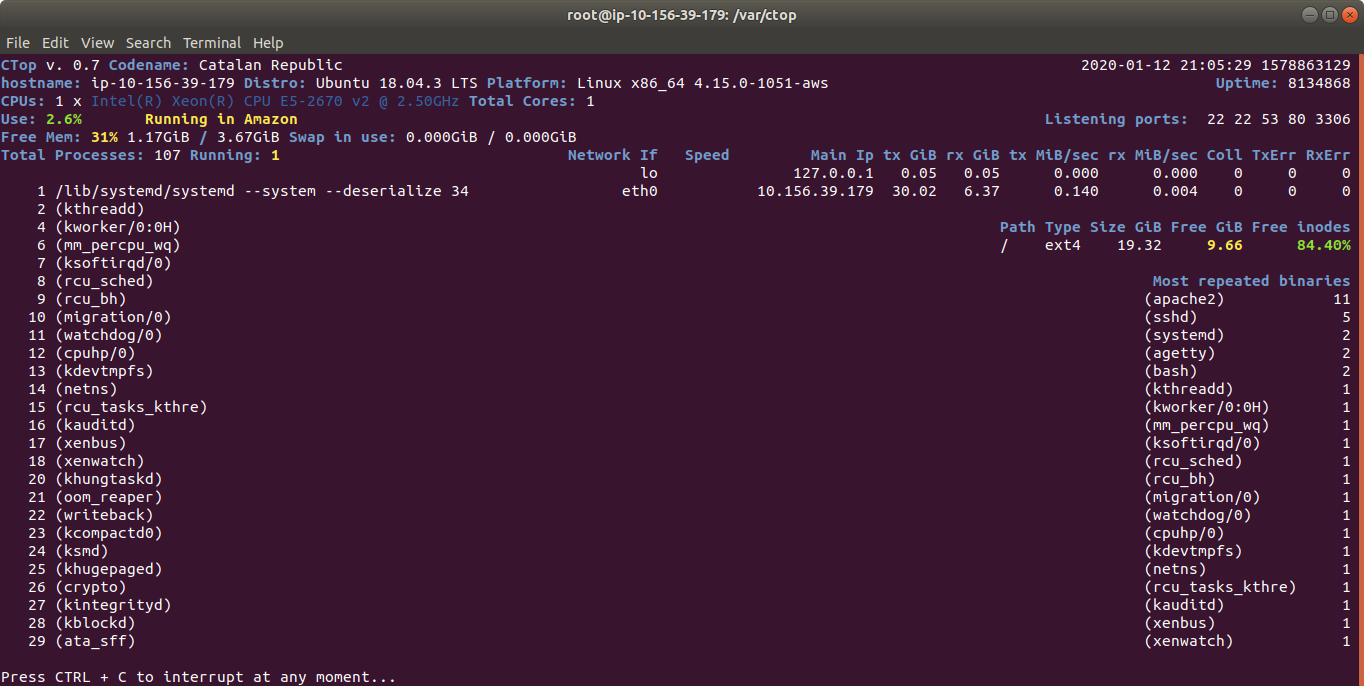
Monitoring an Amazon Instance, take a look at the amount of traffic sent and received

Some of the features I’m working on are parsing the logs checking for errors, kernel panics, processed killed due to lack of memory, iscsi disconnects, nfs errors, checking the logs of mysql and Oracle databases to locate errors

Upgrading the Blog after 5 years, AWS Amazon Web Services, under DoS and Spam attacks

Few days ago I was under a heavy DoS attack.

Nothing new, zombie computers, hackers, pirates, networks of computers… trying to abuse the system and to hack into it. Why? There could be many reasons, from storing pirate movies, trying to use your Server for sending Spam, try to phishing or to host Ransomware pages…

Most of those guys doesn’t know that is almost impossible to Spam from Amazon. Few emails per hour can come out from the Server unless you explicitly requests that update and configure everything.

But I thought it was a great opportunity to force myself to update the Operating System, core tools, versions of PHP and MySql.

Forensics / Postmortem of the incident

The task was divided in two parts:

  • Understanding the origin of the attack
  • Blocking the offending Ip addresses or disabling XMLRPC
  • Making the VM boot again (problems with Amazon AWS)
    • I didn’t know why it was not booting so.
  • Upgrading the OS

I disabled the access to the site while I was working using Amazon Web Services Firewall. Basically I turned access to my ip only. Example: 8.8.8.8/32

I changed 0.0.0.0/0 so the world wide mask to my_Ip/3

That way the logs were reflecting only what I was doing from my Ip.

Dealing with Snapshots and Volumes in AWS

Well the first thing was doing an Snapshot.

After, I tried to boot the original Blog Server (so I don’t stop offering service) but no way, the Server appeared to be dead.

So then I attached the Volume to a new Server with the same base OS, in order to extract (dump) the database. Later I would attach the same Volume to a new Server with the most recent OS and base Software.

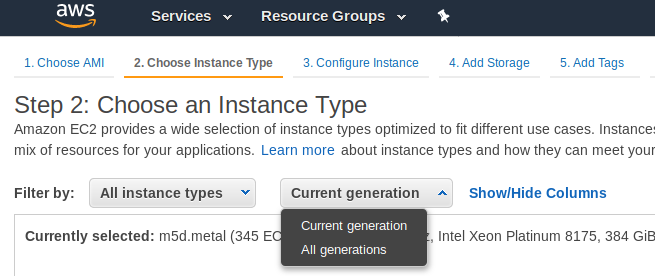
Something that is a bit annoying is that the new Instances, the new generation instances, run only in VPC, not in Amazon EC2 Classic. But my static Ip addresses are created for Amazon EC2 Classic, so I could not use them in new generation instances.

I choose the option to see all the All the generations.

Upgrading the system base Software had its own challenges too.

Upgrading the OS / Base Software

My approach was to install an Ubuntu 18.04 LTS, and install the base Software clean, and add any modification I may need.

I wanted to have all the supported packages and a recent version of PHP 7 and the latest Software pieces link Apache or MySQL.

sudo apt update

sudo apt install apache2

sudo apt install mysql-server

sudo apt install php libapache2-mod-php php-mysql

Apache2

Config files that before were working stopped working as the new Apache version requires the files or symlinks under /etc/apache2/sites-enabled/ to end with .conf extension.

Also some directives changed, so some websites will not able to work properly.

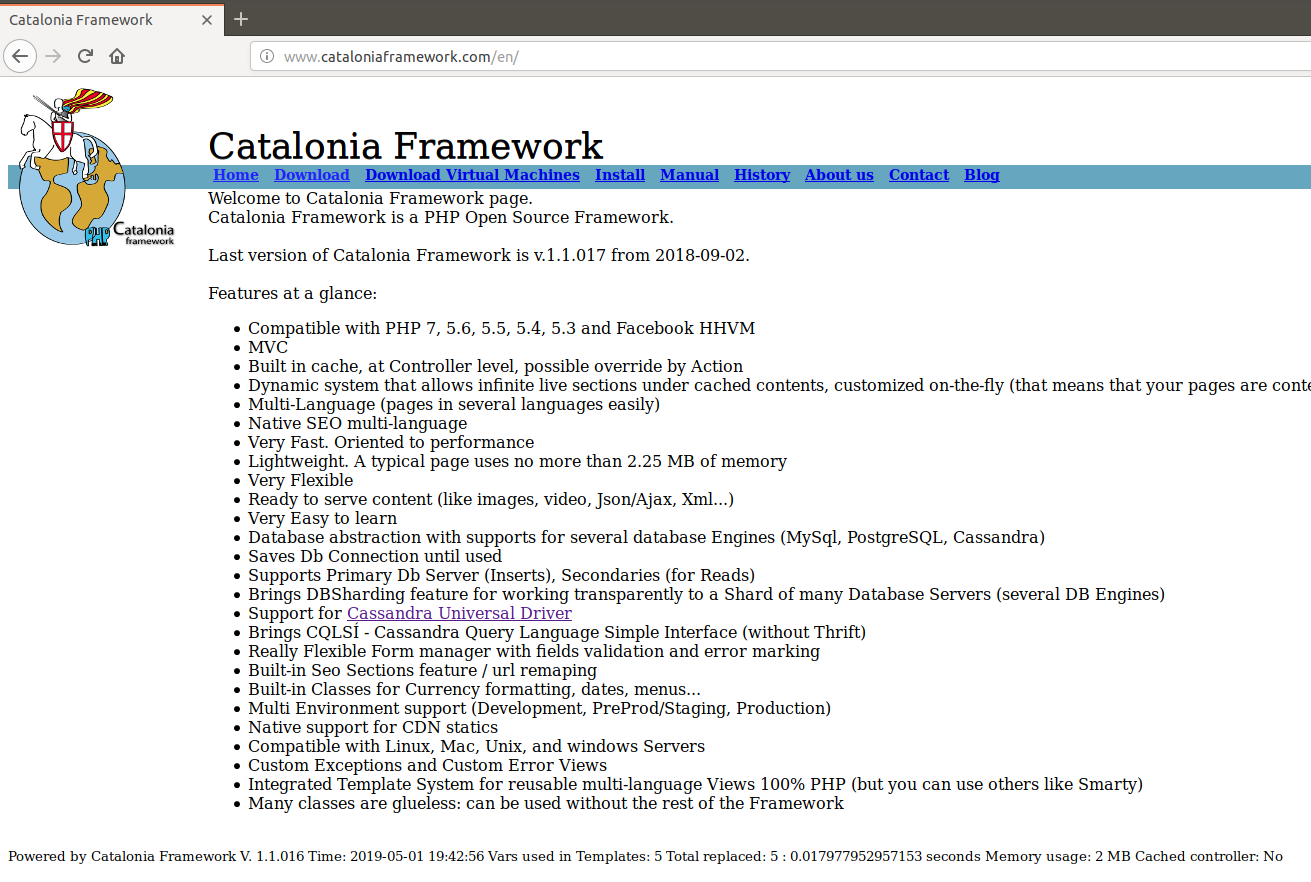
Those projects using my Catalonia Framework were affected, although I have this very well documented to make it easy to work with both versions of Apache Http Server, so it was a very straightforward change.

From the previous version I had to change my www.cataloniaframework.com.conf file and enable:

    <Directory /www/www.cataloniaframework.com>
Options Indexes FollowSymLinks MultiViews
AllowOverride All
Order allow,deny
allow from all
</Directory>

Then Open the ports for the Web Server (443 and 80).

sudo ufw allow in "Apache Full"

Then service apache restart

Catalonia Framework Web Site, which is also created with Catalonia Framework itself once restored

MySQL

The problem was to use the most updated version of the Database. I could use one of the backups I keep, from last week, but I wanted more fresh data.

I had the .db files and it should had been very straightforward to copy to /var/lib/mysql/ … if they were the same version. But they weren’t. So I launched an instance with the same base Software as the old previous machine had, installed mysql-server, stopped it, copied the .db files, started it, and then I made a dump with mysqldump –all-databases > 2019-04-29-all-databases.sql

Note, I copied the .db files using the mythical mc, which is a clone from Norton Commander.

Then I stopped that instance and I detached that volume and attached it to the new Blog Instance.

I did a Backup of my original /var/lib/mysql/ files for the purpose of faster restoring if something went wrong.

I mounted it under /mnt/blog_old and did mysql -u root -p < /mnt/blog_old/home/ubuntu/2019-04-29-all-databases.sql

That worked well I had restored the blog. But as I was watching the /var/log/mysql/error.log I noticed some columns were not where they should be. That’s because inadvertently I overwritten the MySql table as well, which in MySQL 5.7 has different structure than in MySQL 5.5. So I screwed. As I previewed this possibility I restored from the backup in seconds.

So basically then I edited my .sql files and removed all that was for the mysql database.

I started MySql, and run the mysql import procedure again. It worked, but I had to recreate the users for all the Databases and Grant them permissions.

GRANT ALL PRIVILEGES ON db_mysqlproxycache.* TO 'wp_dbuser_mysqlproxy'@'localhost' IDENTIFIED BY 'XWy$&{yS@qlC|<¡!?;:-ç';

PHP7

Some modules in my blogs where returning errors in /var/log/apache2/mysite-error.log so I checked that it was due to lack of support of latest PHP versions, and so I patched manually the code or I just disabled the offending plugin.

WordPress

As seen checking the /var/log/apache2/blog.carlesmateo.com-error.log some URLs where not located by WordPress.

For example:

The requested URL /wordpress/wp-json/ was not found on this server

I had to activate modrewrite and then restart Apache.

a2enmod rewrite; service apache2 restart

Making the site more secure

Checking at the logs of Apache, /var/log/apache2/blog.carlesmateo.com-access.log I checked for Ip’s accessing Admin areas, I looked for 404 Errors pointing to intents to exploit any unsafe WP Plugin, I checked for POST protocol as well.

I added to the Ubuntu Uncomplicated Firewall (UFW) the offending Ip’s and patched the xmlrpc.php file to exit always.

Stopping a BitTorrent DDoS attack

After all the success about the article stopping an XMLRPC to WordPress site attack and thanks messages (I actually helped a company that was being thrown down every day and asked me for help) it’s the moment to explain how to stop an attack much more heavily in evilness.

The first sign I saw was that the server was more and more slower, what is nearly impossible as I setup a very good server, and it has a lot of good development techniques to not having bottlenecks.

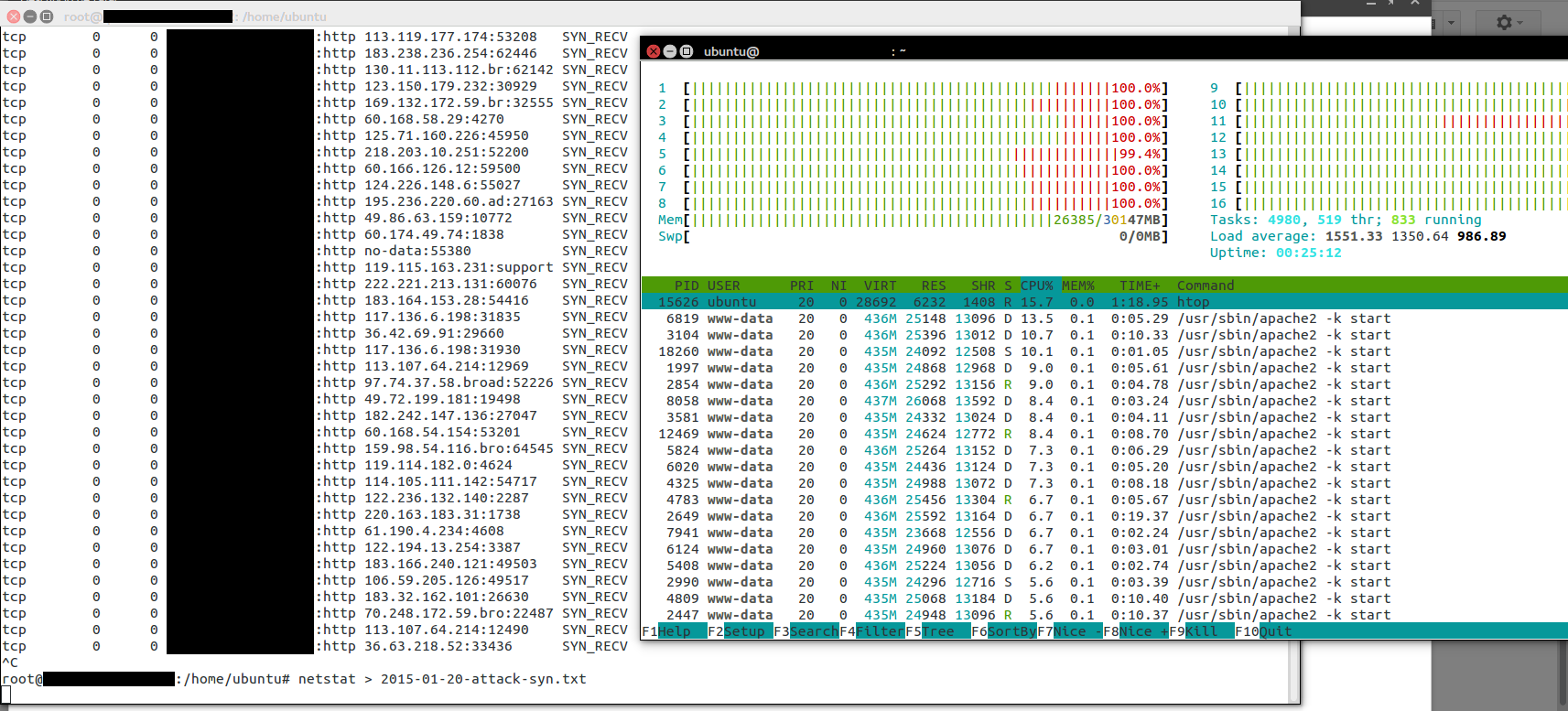
I looked at the server and I saw like 3,000 SYN_SENT packets. Apparently we were under a SYN Flood attack.

blog-carlesmateo-com-atack-to-the-web-2015-high-load-blacknetstat revealed more than 6k different ip addresses connecting to the Server.

Server had only 30 GB of RAM so, and started to be full, with more and more connections, and so more Apache processes to respond to the real users fast it was clear that it was going to struggle.

I improved the configuration of the Apache so the Server would be able to handle much more connections with less memory consumption and overhead, added some enhancements for blocking SYN Flood attacks, and restarted the Apache Server.

I reduced greatly the scope of the attacks but I knew that it would only be being worst. I was buying time while not disrupting the functioning of the website.

The next hours the attacks increased to having around 7,500 concurrent connections simultaneously. The memory was reaching its limits, so I decided it was time to upgrade the instance. I doubled the memory and added much more cores, to 36, by using one of the newest Amazon c4.8xlarge.

blog-carlesmateo-com-heavy-load-with-c4-8xlarge-black

The good thing about Cloud is that you pay for the time you use the resources. So when the waters calm down again, I’m able to reduce the size of the instance and save some hundreds to the company.

I knew it was a matter of time. The server was stabilized at using 40 GB out of the 60 GB but I knew the pirates will keep trying to shutdown the service.

Once the SYN Flood was stopped and I was sure that the service was safe for a while, I was checking the logs to see if I can detect a pattern among the attacks. I did.

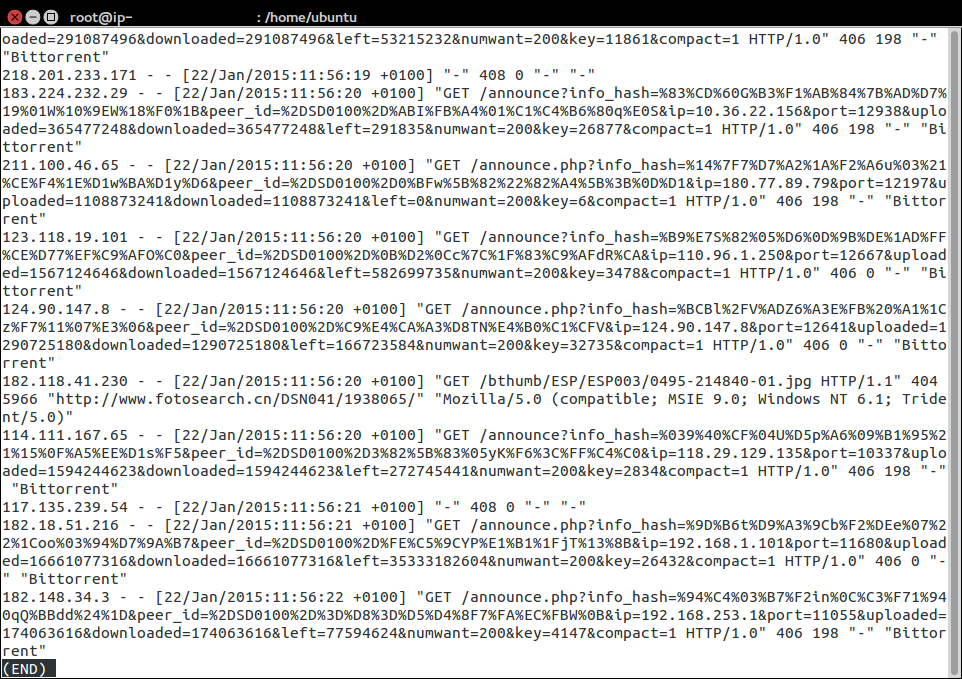
attacks-access-log-bittorrent

Most request that we were receiving where to a file called announce.php that obviously does not exist in the server, and so it was returning 404 error.

The user agent reported in many cases BitTorrent, or Torrent compatible product, and the url sending a hash, uploaded, downloaded, left… so I realized that somehow my Server was targeted by a Torrent attack, where they indicated that the Server was a Torrent tracker.

As the .htacess in frameworks like Laravel, Catalonia Framework… and CMS like WordPress, Joomla, ezpublish… try to read the file from filesystem and if it doesn’t exist index.php is served, then as first action I created a file /announce.php that simple did an exit();

Sample .htaccess from Laravel:

<IfModule mod_rewrite.c>
    <IfModule mod_negotiation.c>
        Options -MultiViews
    </IfModule>

    RewriteEngine On

    # Redirect Trailing Slashes...
    RewriteRule ^(.*)/$ /$1 [L,R=301]

    # Handle Front Controller...
    RewriteCond %{REQUEST_FILENAME} !-d
    RewriteCond %{REQUEST_FILENAME} !-f
    RewriteRule ^ index.php [L]
</IfModule>

Sample code for announce.php would be like:

<?php
/**
 * Creator: Carles Mateo
 * Date: 2015-01-21 Time: 09:39
 */

// A cheap way to stop an attack based on requesting this file
http_response_code(406);
exit();

The response_code 406 was an attemp to see if the BitTorrent clients were sensible to headers and stop. But they didn’t.

With with simple addition of announce.php , with exit(), I achieved reducing the load on the Server from 90% to 40% in just one second.

The reason why a not found page was causing so many damage was that as the 404 error page from the Server is personalized, and offers alternative results (assuming the product you was looking for is no longer available), and before displaying all the Framework is loaded and the routes are checked to see if the url fits and so has some process to be done in the PHP side (it takes 100 ms to reply, is not much, but it was not necessary to waste so much CPU), even being very optimized, every single not found url was causing certain process and CPU waste. Since the attack had more than 7,000 different ip’s simultaneously coming to the Server it would be somewhat a problem at certain point and start returning 500 errors to the customers.

The logs were also showing other patterns, for example:

announce?info_hash…

So without the PHP extension. Those kind of requests would not go through my wall file announce.php but though index.php (as .htaccess tells what is not found is directed there).

I could change the .htaccess to send those requests to hell, but I wanted a more definitive solution, something that would prevent the Server from wasting CPU and the Servers to being able to resist an attack x1000 times harder.

At the end the common pattern was that the BitTorrent clients were requesting via GET a parameter called info_hash, so I blocked through there all the request.

I wrote this small program, and added it to index.php

// Patch urgency Carles to stop an attack based on Torrent
// http://blog.carlesmateo.com
if (isset($_GET['info_hash'])) {

    // In case you use CDN, proxy, or load balancer
    $s_ip_proxy = '';

    $s_ip_address = $_SERVER['REMOTE_ADDR'];


    // Warning if you use a CDN, a proxy server or a load balancer do not add the ip to the blacklisted
    if ($s_ip_proxy == '' || ($s_ip_proxy != '' && $s_ip_address != $s_ip_proxy)) {
        $s_date = date('Y-m-d');

        $s_ip_log_file = '/tmp/ip-to-blacklist-'.$s_date.'.log';
        file_put_contents($s_ip_log_file, $s_ip_address."\n", FILE_APPEND | LOCK_EX);
    }


    // 406 means 'Not Acceptable'
    http_response_code(406);
    exit();
}


Please note, this code can be added to any Software like Zend Framework, Symfony, Catalonia Framework, Joomla, WordPress, Drupal, ezpublish, Magento… just add those lines at the beginning of the public/index.php just before the action of the Framework starts. Only be careful that after a core update, you’ll have to reapply it.

After that I deleted the no-longer-needed announced.php

What the program does is, if you don’t have defined a proxy/CDN ip, to write the ip connecting with the Torrent request pattern to a log file called for example:

/tmp/ip-to-blacklist-2015-01-23.log

And also exit(), so stopping the execution and saving many CPU cycles.

The idea of the final date is to blacklist the ip’s only for 24 hours as we later will see.

With this I achieved reducing the CPU consumption to around 5-15% of CPU.

Then, there is the other part of stopping the attack, that is a bash program, that can be run from command line or added to cron to be launched, depending on the volume of the attacks, every 5 minutes, or every hour.

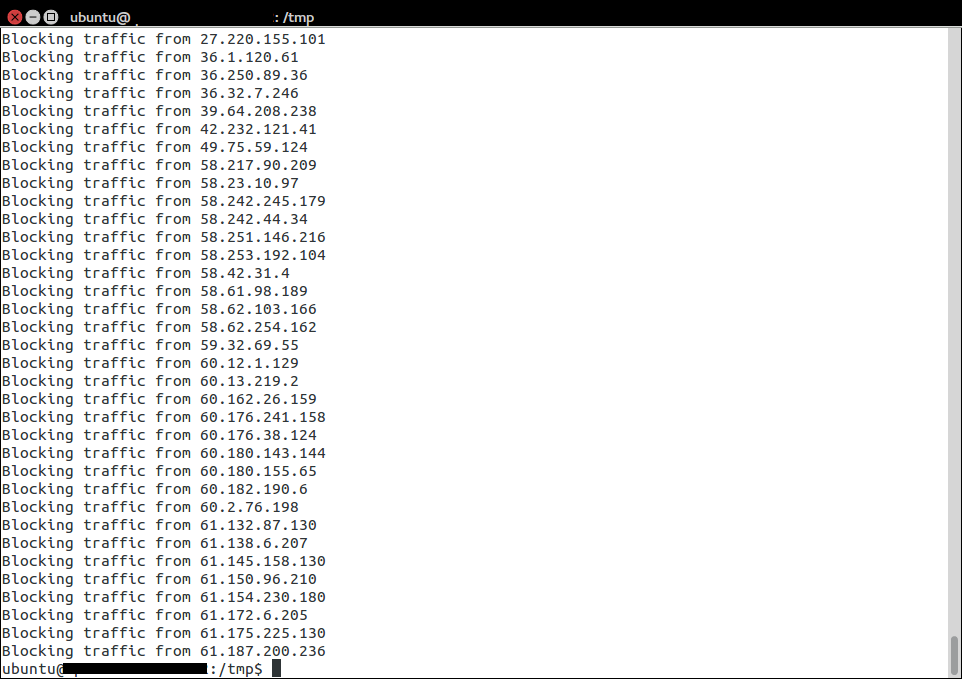
blog-carlesmateo-com-blocking-traffick-black

ip_blacklist.sh

#!/bin/bash
# Ip blacklister by Carles Mateo
s_DATE=$(date +%Y-%m-%d)
s_FILE=/tmp/ip-to-blacklist-$s_DATE.log
s_FILE_UNIQUE=/tmp/ip-to-blacklist-$s_DATE-unique.log
cat $s_FILE | sort | uniq > $s_FILE_UNIQUE

echo "Counting the ip addresses to block in $s_FILE_UNIQUE"
cat $s_FILE_UNIQUE | wc -l

sleep 3
# We clear the iptables rules
iptables -F
iptables -X
iptables -t nat -F
iptables -t nat -X
iptables -t mangle -F
iptables -t mangle -X
iptables -P INPUT ACCEPT
iptables -P FORWARD ACCEPT
iptables -P OUTPUT ACCEPT

# To list the rules sudo iptables -L
# /sbin/iptables -L INPUT -v -n
# Enable ssh for all (you can add a Firewall at Cloud provider level or enstrict the rule to your ip)
sudo iptables -A INPUT -p tcp --dport ssh -j ACCEPT

for s_ip_address in `cat $s_FILE_UNIQUE`
do
    echo "Blocking traffic from $s_ip_address"
    sudo iptables -A INPUT -s $s_ip_address -p tcp --destination-port 80 -j DROP
    sudo iptables -A INPUT -s $s_ip_address -p tcp --destination-port 443 -j DROP
done

# Ensure Accept traffic on Port 80 (HTTP) and 443 (HTTPS)
sudo iptables -A INPUT -p tcp --dport 80 -j ACCEPT
sudo iptables -A INPUT -p tcp --dport 443 -j ACCEPT

# To block the rest
# sudo iptables -A INPUT -j DROP

# User iptables -save and iptables -restore to make this changes permanent
# sudo sh -c "iptables-save > /etc/iptables.rules"
# sudo pre-up iptables-restore < /etc/iptables.rules
# https://help.ubuntu.com/community/IptablesHowTo

This scripts gets the list of ip’s addresses, gets the list of unique ip’s into another file, and then makes a loop and adds all of them to the iptables, the Firewall from Linux, and blocks them for accessing the web at port 80 (http) or 443 (https, ssl). You can block all the ports also if you want for those ip’s.

With this CPU use went to 0%.

Note: One of my colleagues, a wonderful SysAdmin at Ackstorm ISP, points that some of you may prefer using REJECT instead of DROP. An interesting conversation on serverfault about this.

After fixing the problem I looked over the Internet to locate any people reporting attacks like what I suffered. The most interesting I found was this article: BotTorrent: Misusing BitTorrent to Launch DDoS Attacks, from University of California, Irvine. (local copy on this website BotTorrent)

Basically any site on the Internet can be attacked at a large scale, as every user downloading Torrent will try to connect to the innocent Server to inform of the progress of the down/upload. If this attack is performed with hundreds of files, the attack means hundreds of thousands of ip’s connecting to the Server… the server will run out of connections, or memory, or bandwidth will be full from the bad traffic.

I saw that the attackers were using porno files that were highly downloaded and apparently telling the Torrent network that our Server was a Torrent tracker, so corroborating my hypothesis all the people downloading Torrents were sending updates to our Server, believing that our Server was a tracker. A trick from the sad pirates.

Some people, business users, asked me who could be interested in injuring other’s servers or disrupting other’s businesses without any immediate gain (like controlling your Servers to send Spam).

I told:

  • Competitors that hate you because you’re successful and want to disrupt your business (they pay to the pirates for doing attacks. I’ve helped companies that were let down by those pirates)
  • Investors that may want to buy you at a cheaper price (after badly trolling you for a week or two)
  • False “security” companies that will offer their services “casually” when you most need them and charge a high bill
  • Pirates that want to extort you

So bad people that instead that using their talent to create, just destroy and act bad being evil to others.

In other cases could be bad luck to have been assigned an Ip that previously had a Torrent tracker, it has not much sense for the Cloud as it is expensive, but it has that a Server with that ip was hacked and used as tracked for a while.

Also governments could be so wanting to disrupt services (like torrent) by clumsy redirecting dns to random ip’s, or entertainment companies trying to shutdown Torrent trackers could try to poison dns to stop users from using Bittorrent.


See the definitive solution in the next article.